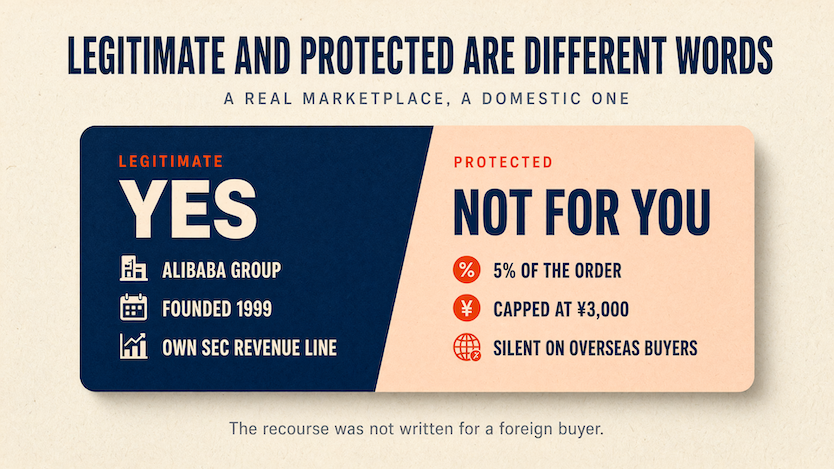

1688 is a real Alibaba Group marketplace, not a clearance channel for rejects. The honest risks are different from the ones people warn you about, and most of them are about you, not the platform.
Is 1688 legit? Yes. It is a genuine Alibaba Group marketplace, founded in 1999, with over a million paying members (a seller product, so a supplier count rather than a buyer count) and its own line in Alibaba’s SEC filings. That is the easy half of the question, and it is where most articles stop.
The half that matters is narrower: legitimate for whom, and with what recourse. 1688 was built for Chinese domestic buyers, and almost every protection it offers is scoped to them. Its buyer protection pays 5% of the order, capped at ¥3,000. Its escrow releases when someone signs for your cartons at a Chinese forwarder, weeks before anyone who works for you opens one.
| Get a counterparty you can actually pursue. Buy from 1688 through a Western company that carries the risk: pre-shipment checks, all-in pricing in your currency, and one invoice. ➜ See how it works |
|---|
Is 1688 legit, or is it a scam?
1688 is legitimate. It is Alibaba Group’s domestic Chinese wholesale marketplace, founded in 1999, reported on its own revenue line in Alibaba’s SEC filings: China commerce wholesale, which Alibaba says is primarily generated from 1688.com, which earned RMB 26,312 million in FY2026, roughly level with the Alibaba.com-led international wholesale line.
Alibaba Group’s own description calls 1688.com China’s leading integrated domestic wholesale marketplace, known as the “product source for Chinese e-commerce,” with over 1 million paying members as of fiscal year 2024. That figure counts sellers, not buyers. Separately, Chinese tech media reported in March 2025 that 1688’s annual active buyer count had passed 100 million as of February 2025: a company announcement rather than an audited figure, but it gives the scale.
The structural proof is in Alibaba’s reporting for the financial year ended 31 March 2026. 1688 and Alibaba.com sit in two different business groups: 1688 under the China commerce wholesale revenue line inside Alibaba China E-commerce Group (the segment reported as Taobao and Tmall Group until FY2026) and Alibaba.com under international commerce wholesale inside Alibaba International Digital Commerce Group. The revenue footnotes are word-for-word parallel: both earn from membership fees, value-added services and customer management services. Neither is described as a surplus or liquidation channel.
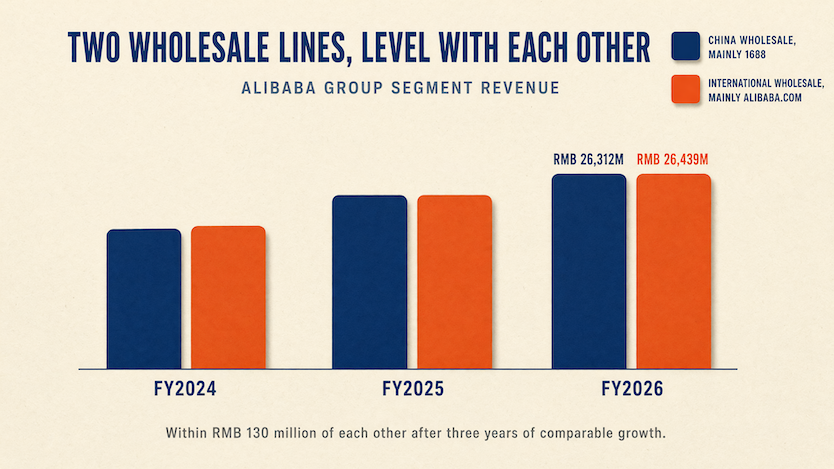
Segment revenue is membership and advertising, so it says nothing about where inventory originates. What it shows is two comparable businesses, not a marketplace subordinate to the other. Figures from Alibaba’s fiscal year 2026 results, released 12 May 2026. · alt: Alibaba Group segment revenue from FY2024 to FY2026 showing the China wholesale line, primarily 1688.com, level with the international wholesale line led by Alibaba.com.
| Revenue line | FY2024 | FY2025 | FY2026 |
|---|---|---|---|
| China commerce wholesale (primarily 1688.com) | RMB 20,479m | RMB 24,301m | RMB 26,312m (+8%) |
| International commerce wholesale (primarily Alibaba.com) | RMB 20,944m | RMB 23,835m | RMB 26,439m (+11%) |
| What this does and does not prove Segment revenue is advertising and membership fees, so it says nothing about where inventory physically originates. What it does show is that on Alibaba’s own books the two wholesale lines are now within RMB 130 million of each other and have grown at comparable rates for three years, which is hard to square with the idea that 1688 is a subordinate outlet for Alibaba.com. Figures from Alibaba’s March quarter and fiscal year 2026 results, released 12 May 2026. |
|---|
Is 1688 just Alibaba’s rejects and surplus stock?
No, and the claim is inverted. The most repeated version of it, that 1688 carries QA rejects you can “dumpster dive”, sits at 1 net upvote on Reddit with two replies, one of them disputing it, while answers saying 1688 is safe run from roughly +9 to +32 in the same communities.
It is worth looking at the actual evidence for this myth, because it is thinner than its reach suggests. The clearest statement of it is an October 2025 comment in r/Alibaba:
| The claim “1688 is the product surplus from Alibaba in which the quality is considered “reject” from QA of other individuals/companies. It is best not to rely on the platform if you want quality. However, if your business relies on selling low priced (low quality) products then you can dumpster dive this platform.” (u/Chinksta, r/Alibaba, 28 October 2025) |
|---|
Under Reddit’s default comment order that is the first readable answer in the thread; the only thing above it is a removed comment. It has one net upvote. One person replied to push back, “I don’t think they are the DH gate rejects 🤣🤣 I reckon 1688 sell them at the price they should sell for”, and the only other reply just asked a follow-up question. Sorted by top, it falls to 32nd of 35. That is what an un-upvoted, factually inverted claim looks like when it happens to sit where a crawler lands first (retrieved 9 August 2026; Reddit fuzzes vote counts).
The flow actually runs the other way, and the best-known sceptic on this topic concedes it on camera. In a 2020 video arguing against buying from 1688 (173,977 views as of August 2026) Sourcing with Kian describes Alibaba middlemen as resellers rather than manufacturers: they take the order, have a 1688 factory produce it, and “add a margin” before passing it on. A seller in r/AmazonFBA puts the same point from the buying side: “I’ve worked with 1688… Quality is same as Alibaba because products come from the same factories.” We take that argument apart properly in 1688 vs Alibaba.
Two governments have also looked and declined to list it. 1688 appears zero times in the USTR’s 2025 Review of Notorious Markets, released 3 March 2026, which names Taobao, DHgate, Pinduoduo and Douyin Mall. In the EU’s May 2025 Counterfeit and Piracy Watch List it appears once, nominated by stakeholders but not listed, with the Commission finding the nominated Alibaba platforms “can overall be considered as adhering to a good industry standard, while they still need to continue making efforts and cooperate further with rightholders and law enforcement authorities.” Neither absence is a certification that no counterfeits exist there (it reflects a nomination-and-review process), but nobody ranking for this question has cited either document.
What buyer protection does 1688 actually give you?
Real protection, thinly capped, and silent on whether you qualify. 1688 runs Alipay escrow and a codified buyer-protection scheme paying 5% of the order value, capped at ¥3,000, and only ¥500 on the genuine-factory guarantee. There is no Trade Assurance equivalent.
This is the part that gets overstated in both directions. 1688 is not the unprotected free-for-all the sceptics describe: since 2 February 2024, 7-day no-reason returns have been the default on in-stock listings set at a one-unit minimum, and the Buyer Protection Service Agreement (version 20240912) requires merchants to post a cash deposit that 1688 can instruct Alipay to debit. But the payouts are small, and they are not uniform.
| Guarantee | What it covers | Payout |
|---|---|---|
| On-time delivery guarantee | Late shipping | 5% of the sub-order excluding freight, max ¥3,000 |
| Quality guarantee | Quality failure | 5%, max ¥3,000 |
| Size-mismatch guarantee | Size mismatch | 5%, max ¥3,000 |
| Transit-damage guarantee | Transit damage | 5%, max ¥3,000 |
| Misprint guarantee | Wrong printing on customised goods | 5%, max ¥3,000 |
| Genuine-factory guarantee | The seller is not actually a factory | 5%, max ¥500 |
| Inspection reimbursement | Approved third-party inspection showing material mismatch | Up to ¥5,000 (¥1,000 if the test destroys the goods) |
| The finding that matters, and it is a silence The agreement sets no geographic eligibility test in either direction. It does not grant overseas buyers access to these guarantees, and it does not exclude them. Do not read that as “1688 now has buyer protection equivalent to Trade Assurance”. It plainly does not, at 5% capped at ¥3,000. Practitioners report it does not reach them: “I’ve worked with 1688, they don’t offer buyer protection to foreign buyers.” Treat the protection as domestic until you have tested it on a small order. |
|---|
Meanwhile the English terms you actually contract under are blunt about it. World.1688’s Terms of Use state the platform “does not control and is not liable or responsible for the quality, safety, lawfulness or availability of the products or services offered for sale on the Sites,” that “because user verification on the Internet is difficult, World.1688 cannot and does not confirm each User’s purported identity,” and that buyers assume the risk of “mis-representation of products and services, fraudulent schemes, unsatisfactory product quality… defective or dangerous products, unlawful products.” That is a standard marketplace disclaimer, but it is the operative one.
How do you tell a real 1688 supplier from a risky one?
Read the paid badges as a spending signal, not a quality one. The entry tier is a marketing subscription. The middle tier costs from ¥36,800 a year and adds a third-party on-site audit. The top tier costs from ¥106,800 and adds a manufacturing-capability test on top of that same inspection.
1688 runs several merchant programmes; the three that matter for judging a supplier are China TrustPass, Powerful Merchant and Super Factory, and all three are paid. That does not make them worthless; it changes what they mean. A six-figure-RMB annual badge is strong evidence of a real, audited factory; its absence is weak evidence of anything, because plenty of good small suppliers never buy one.
| Tier | What it actually certifies | Published annual cost |
|---|---|---|
| China TrustPass (诚信通) | Paid membership with enterprise real-name verification. A storefront, marketing and customer-management package, not an independent quality audit | Base paid tier |
| Powerful Merchant (实力商家) | Third-party document review plus on-site inspection: a factory audit for manufacturers, a trader audit for traders. Gated on documentation and an on-site check rather than a shipping-speed threshold | From ¥36,800, plus ¥16,000 deposit frozen |
| Super Factory (超级工厂) | Builds on the same third-party deep certification as Powerful Merchant, then adds a capability screen on one of three routes, only one of which is advanced manufacturing: one of three routes, with plant-area floors from 500 m² to 2,000 m² by route | From ¥106,800, plus ¥16,000 deposit frozen |
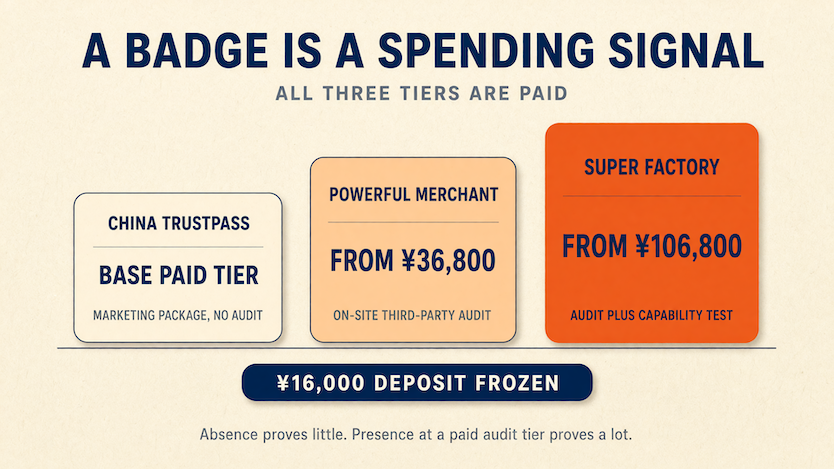
A six-figure-RMB annual badge is strong evidence of a real, audited factory. Its absence is weak evidence of anything, because plenty of good small suppliers never buy one. · alt: The three paid 1688 merchant tiers: China TrustPass as a base marketing package, Powerful Merchant from ¥36,800 with an on-site audit, and Super Factory from ¥106,800 adding a capability test.
In practice the checks run in this order, and the last one is the only one that survives contact with a bad supplier:
- Open the company profile. Registered capital, years in business and headcount are declared there. A company registered eight months ago with three staff may still be fine, but it is not the factory in the photographs.
- Check which badge tier they hold, and price it. China TrustPass means they pay for a storefront. Powerful Merchant (from ¥36,800 a year) means a third party inspected them on site. Super Factory (from ¥106,800) means that inspection plus a manufacturing-capability test. Absence proves little; presence at either paid audit tier proves a lot.
- Read the repeat-buyer rate. It sits alongside description accuracy, response speed and dispatch speed: the four components of 1688’s supplier score, on a rolling 90-day window. Repeat buyers are harder to fake than reviews.
- Weigh sales volume over review count. As one buyer puts it: “Loads of sales usually means it’s good. Reviews can be faked, sales can’t. Loads of sales without reviews hint at B2B sales, so other sellers buying from this factory.”
- Work out whether it is a factory or a trading company. Ask what else they make and what machines they run. A trading company is not disqualifying (it is often better for mixed small orders), but you should know which you are talking to before you negotiate price.
- Ask for a live video call from the floor, not a video file. One buyer’s test: “they sent me videos with my name on a paper while walking around the warehouse and production facility.”
- Ask directly whether they can export, and whether they hold the product certificates your market requires. Most domestic 1688 sellers cannot, which is a logistics question rather than a red flag.
- Order a sample, then book a pre-shipment inspection before the balance is paid. At roughly $300 per man-day this is the only check on the list that catches a problem while it is still the seller’s problem.
What are the real risks of buying from 1688?
Five patterns, and only one is really about the platform. Sellers disengaging from foreigners, fake agents taking payment off-platform by QR code, trading companies presenting as factories, stock that is not in stock, and open trade in replicas, against which US Customs seized 78.4 million items in FY2025.
| Risk | What it looks like | What reduces it |
|---|---|---|
| Sellers refuse foreigners | “Very few sellers will engage with you once they realise you’re not Chinese, and those that will, still add their own markup” | A China-side buyer of record; expect a foreigner premium if you go direct |
| The fake agent | A DM offering to help, then a QR code to a personal wallet: “They sent a scan code which I paid and then there is no update” | Never pay outside the platform’s escrow. This does not happen on 1688 itself. It happens in your DMs |
| Trading company as factory | “There are also a large number of traders and small factories on 1688” | Company-profile checks, a video call, ask what else they make |
| Stock that is not in stock | “They say something is in stock, only for you to wait a week and your agent tells you that the seller actually doesn’t have it” | Confirm stock before paying; check review dates look organic |
| Replicas openly listed | Whole subreddits exist around buying replicas on 1688 | Your problem at your border, not 1688’s. See below |
Note where the money went wrong in the second row. The buyer was not defrauded by a 1688 seller. They were defrauded by someone in their DMs who took payment by QR code, entirely outside 1688’s escrow. It is the loss pattern that recurs most often in buyer forums, and the one the platform cannot help with at all, because the money never entered escrow. That is an argument for settling inside the platform rather than against using it. Our guide to paying on 1688 without Alipay covers which routes actually settle the order and which just pay a person.
The replica risk is real but it is yours, not the platform’s. US Customs seized 78.4 million counterfeit items with an MSRP of $7.4 billion in FY2025, more than double the FY2024 quantity, with China and Hong Kong accounting for roughly 67%, down from about 90% the year before. CBP does not attribute seizures to sourcing platforms, so this quantifies country-level exposure when importing branded goods, not a 1688-specific rate. If a listing shows a brand you do not own, the enforcement happens at your border and the liability is yours.
What recourse do you have if the goods turn out wrong?
Less than the escrow suggests, because of where “receipt” happens. 1688’s escrow releases payment when the buyer confirms the goods arrived, and for a foreign buyer that confirmation happens at a forwarder’s warehouse in China, weeks before anyone opens a carton.
1688’s escrow works the way you would expect. In the platform’s own description of its secured-transaction mechanism: the buyer pays Alipay first, Alipay immediately notifies the seller to ship, and when the buyer receives the goods and is satisfied, they instruct Alipay to release payment to the seller. Money sits with Alipay in between. For a domestic buyer that is a genuinely strong arrangement: the goods arrive at their door, they open the box, and only then does the seller get paid.
Now run the same sequence as an importer. Your goods do not go to your door; they go to a consolidation warehouse in Guangdong or Zhejiang, because the overwhelming majority of 1688 sellers ship domestically only. Somebody there signs for them. The order is complete as far as the platform is concerned. Your cartons then wait to be consolidated, clear export, cross an ocean and clear customs at the other end, and the first time anyone who works for you opens one, the transaction is long since settled and the seller has been paid. Nothing about that is a 1688 failing. It is simply what happens when a domestic-delivery escrow is stretched across a supply chain it was not designed for. 1688 has begun closing that gap itself (its cross-border channel markets an overseas one-piece dropship service), but it does not yet serve US or EU buyers at the scale a Western importer needs, and it does not change the escrow mechanics on a standard 1688 order.
| An inference, stated as one 1688 does not publish a rule saying escrow releases at the forwarder. This is the mechanical consequence of combining its published escrow flow with the fact that delivery is to a Chinese address. Treat it as a structural conclusion rather than a quoted policy, and if you are running real volume, confirm the auto-confirmation window with your agent before you rely on it. |
|---|
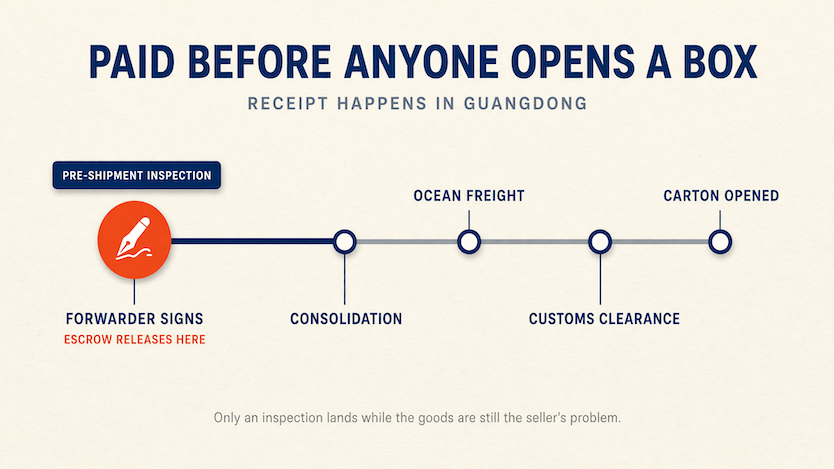
1688 publishes no rule saying escrow releases at the forwarder. This is the mechanical consequence of its published escrow flow combined with domestic-only delivery, so treat it as a structural conclusion rather than a quoted policy. · alt: 1688 escrow releases when a Chinese forwarder signs for the cartons, with consolidation, ocean freight and customs clearance all happening after the seller has been paid.
That is why the practical protection on this platform is not the escrow but the inspection. A third-party pre-shipment check runs $300–$320 per man-day (QIMA publishes $319 for a product inspection in China, and $669 for a supplier audit), and happens while the goods are still in China, still the seller’s problem, and still inside the window where anyone cares. Our guide to arranging quality control directly in China covers how that is booked. It also explains why the fake-agent scam is so effective: money sent by QR code never entered the escrow at all, so there is no order, no counterparty and no window to argue inside.
| Legitimate and protected are different words 1688 is a real marketplace with real recourse. The finding this article keeps returning to is that the recourse was not written for you: capped at 5% of order value or ¥3,000, and silent on whether an overseas buyer can claim at all. There are two ways to close that gap, become a Chinese buyer, or put a company you can actually pursue in your own jurisdiction between you and the seller. Yakkyofy’s 1688 integration is the second: an Italian company as your counterparty, and goods checked at a warehouse in China against what you ordered before they ship on. Prices are on the same footing as everything else on this page: the public catalogue prints the yuan source price beside the converted price on every product, with no account required. A dispute you never have to open is worth more than one you might win. |
|---|
Is it legal for a foreigner to buy from 1688?
Yes. 1688’s terms explicitly contemplate overseas users: if you are outside China you contract with 1688. COM PTE. LTD., a Singapore company registered in December 2023 under UEN 202349153K. There is no nationality bar anywhere in the terms.
This is one of the more useful and least-cited facts about the platform. 1688’s Terms of Service (2024 edition, revised 1 October 2024) state that a user from outside China contracts with 1688. COM PTE. LTD., registered in Singapore. The company checks out against the Singapore government’s ACRA register: UEN 202349153K, entity type “Local Company”, UEN issued 14 December 2023. The separate English Terms of Use then divide the world into “Relevant Jurisdictions” (Russia, Azerbaijan, Armenia, Belarus, Georgia and Moldova) and everywhere else, which the Singapore entity serves. The US and EU fall in the latter.
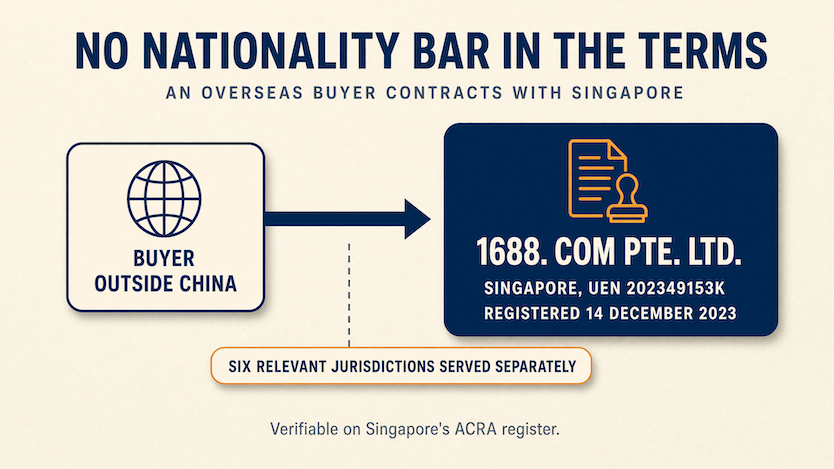
The restrictions in the terms are about capacity and local law, not nationality. Nothing bars a US, UK or EU buyer from holding an account. · alt: Buyers outside China contract with 1688. COM PTE. LTD., a Singapore company registered in December 2023 under UEN 202349153K, with six named jurisdictions served separately.
The restrictions in those terms are about capacity and local law, not nationality: you may not use the site if you are not of legal age to contract, or if you are not permitted to receive the services under the laws of Singapore or of your own country. Nothing bars a US, UK or EU buyer from holding an account.
| Legal is not the same as practical An overseas contracting entity does not make the operational side easy. The cross-border payment rail built for 1688 buyers, World Pay, is operated by WorldFirst (part of Ant International, an Alibaba affiliate rather than a group subsidiary) and settles in offshore RMB only. Its mainland help pages list mainland China, Hong Kong, Singapore, Malaysia, Thailand, Vietnam, Australia, New Zealand and Indonesia, while WorldFirst separately runs UK and EU entities offering the same product. The US is the notable gap. Last reviewed August 2026. |
|---|
So should you buy from 1688 or not?
Buy from it if you can put something between you and the transaction. The platform is legitimate and its factories supply the same goods sold on Alibaba.com; what it does not give a foreign buyer is recourse, and a 5% payout capped at ¥3,000 is not recourse on a real order.
The honest summary is that almost everything you would want to lean on is domestically scoped. Escrow is an Alipay mechanism. The buyer-protection payouts are silent on whether you qualify. The 7-day return default assumes a mainland return address. The badges are Chinese-language and domestic-facing. The official foreign payment rail does not serve your market. None of that makes 1688 a scam. It makes it a marketplace you should not enter unrepresented.
Three routes close that gap: a sourcing agent, a China-side buying entity of your own, or a platform that becomes the buyer of record for you. Yakkyofy, which publishes this guide, does the third, goods are sourced from 1688, checked at its Dongguan warehouse before dispatch, invoiced in your currency by a company listed on Borsa Italiana’s Euronext Growth Milan market, and shipped worldwide, with orders supported from a single unit. The relevant difference for this article is not price: it is that a Western-invoiced counterparty is a counterparty you can actually pursue. See the 1688 integration or current pricing, and for the same trust question on the export platform, is Alibaba legit.
| Test the platform without carrying the counterparty risk: source one unit from 1688, checked before it ships, priced all-in, in your currency. ➜ Try it on your product |
|---|
Yakkyofy handles 1688 sourcing, consolidation, quality checks and duty forecasting from a single unit up, so you don’t need to solve these problems yourself.
Frequently asked questions
Is 1688 legit?
Yes. 1688.com is Alibaba Group’s domestic Chinese wholesale marketplace, founded in 1999, with over 1 million paying suppliers and its own revenue line in Alibaba’s SEC filings: China commerce wholesale, which Alibaba says is primarily generated from 1688.com, and which earned RMB 26,312 million in FY2026, roughly level with the Alibaba.com-led international wholesale line. The real question is not whether the platform is genuine but what recourse you have as a foreign buyer, which is limited.
Is 1688 just rejects or surplus stock from Alibaba?
No, that claim is inverted. Alibaba reports the two marketplaces as separate segments in different business groups, monetised identically, and neither is described as a surplus channel. In practice many Alibaba.com sellers are middlemen who have the order made by a 1688 factory, which is the opposite of the myth. Even the most-watched video arguing against 1688 concedes this on camera.
Is 1688 safe to buy from?
The platform is safe in the sense that it is real, runs Alipay escrow and has a codified buyer-protection scheme. The limits are what matter: payouts are 5% of the order capped at ¥3,000, and only ¥500 on the genuine-factory guarantee, and the agreement says nothing about whether overseas buyers qualify. There is no equivalent of Alibaba.com’s Trade Assurance. Treat a pre-shipment inspection as your real protection.
Is it legal to buy from 1688 as a foreigner?
Yes. 1688’s terms state that users outside China contract with 1688. COM PTE. LTD., a Singapore company registered in December 2023 under UEN 202349153K, verifiable on Singapore’s ACRA register. The terms contain no nationality bar, only the usual requirements that you be of legal age and permitted to receive the services under your own country’s law.
Are there counterfeits on 1688?
Yes, and buying them is your legal exposure, not the platform’s. 1688 was named zero times in the USTR’s 2025 Notorious Markets review and was nominated but not listed on the EU’s 2025 Watch List, so neither government treats it as a priority offender, but US Customs seized 78.4 million counterfeit items worth $7.4 billion MSRP in FY2025, with China and Hong Kong about 67% of the quantity, down from roughly 90% in FY2024. Enforcement happens at your border.
What is the most common way people lose money on 1688?
Not a 1688 seller: a fake agent. The recurring pattern is a direct message offering to help an overseas buyer, followed by a QR code to a personal wallet: as one buyer described it, “They sent a scan code which I paid and then there is no update.” The payment never enters 1688’s escrow, so there is no order to dispute. Settling inside the platform is the single biggest risk reduction available.


