
Two Alibaba Group marketplaces, two different buyers, and one price gap nobody has measured properly. What the difference actually is, and what it costs you either way.
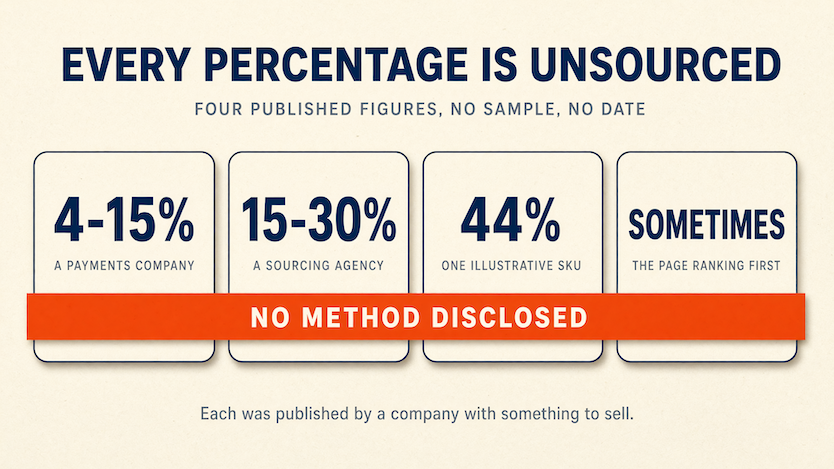
1688 vs Alibaba is usually presented as a price question with a known answer. It is not. Every percentage in circulation (4–15%, 15–30%, a single-SKU example implying 44%) was published by a company with something to sell. Pick your channel on any of them and you are budgeting against a number nobody has measured.
So this comparison does two things differently. It states plainly what is known about the price gap and who published each figure, rather than repeating one. And it works through the most-watched argument against buying from 1688 (a 2020 video with 173,977 views) objection by objection, because two of its seven pillars have since expired, two do not survive a careful look at the video itself, and nobody has said so.
| The 1688 price without the Chinese-only search, the forwarder or the export paperwork: see what a unit costs with goods, handling and freight converted into your currency, before you commit. → Price one unit, all in ➜ See how it works |
|---|
What is the actual difference between 1688 and Alibaba?
Same parent, different buyers. Alibaba reports them in two separate business groups, and their audiences barely overlap: 1688 passed 100 million annual active buyers in China as of February 2025, while Alibaba.com is built for exporters and quotes in English and dollars.
Both platforms belong to Alibaba Group, but they are not divisions of one product. The accounts separate them.
The practical differences follow from who each one is for. We covered the channel-level basics in buying from China on 1688, so this table takes the axes that comparison did not: who can actually transact, what recourse exists, and what it takes to get from browsing to a delivered box.
| 1688 | Alibaba.com | |
|---|---|---|
| Who can register and transact | Overseas users contract with 1688. COM PTE. LTD. (Singapore). No nationality bar, but 1688.com, kj.1688.com and global.1688.com all still render Chinese-only (checked August 2026) | Built for international buyers; English throughout |
| Dispute mechanism | Alipay escrow plus buyer protection capped at 5% / ¥3,000, silent on overseas eligibility | Trade Assurance, materially stronger for a cross-border buyer |
| Supplier export standing | Most sellers are domestic and hold no customs registration | Sellers are export-oriented by design |
| How you find products | Image search does the work; keyword search assumes Mandarin | English keyword search and category trees |
| Price presentation | Tiered by quantity, RMB, usually VAT-inclusive | Quoted per MOQ band, typically USD, export-priced |
| Who bears the customs burden | You, or your forwarder: the seller’s job ends at a Chinese address | Often shared; suppliers routinely quote FOB or DDP |
| Realistic setup for a Western buyer | Verified mainland Alipay account, a forwarder, usually an agent | An account and a card |
One row in that table surprises people: 1688 does not bar foreign buyers. Its terms state that a user outside China contracts with 1688. COM PTE. LTD., a Singapore company registered in December 2023 under UEN 202349153K and verifiable on Singapore’s ACRA register. The restrictions in those terms are about capacity and local law, not nationality. What stops Western buyers is not permission. It is that the main marketplace renders Chinese-only and the sellers ship domestically. Payment is less of a barrier than it was: the official rail, World Pay, is run with WorldFirst and has dedicated UK and EU entities alongside its Asia-Pacific coverage. The US is the notable gap: WorldFirst does not serve US businesses.
Is 1688 cheaper than Alibaba, and by how much?
Almost certainly yes, and nobody has measured it. Every price-gap figure we could trace (4–15%, 15–30%, and a single-SKU example implying 44%) is either supplied by an interested party or published without a disclosed method. Not one states a sample size, a date or a comparison rule.
This is the part of the comparison everyone wants and everyone fudges. Below is every figure we could trace to a publisher, with who published it and whether a method was disclosed. The pattern is the finding.
| Figure | Published by | What it actually compares | Method disclosed? |
|---|---|---|---|
| “typically 4% to 15% lower, and in some cases up to 40% lower” | WorldFirst, a payments company owned by Ant International | Other B2B platforms in the Chinese market, not Alibaba.com. WorldFirst footnotes it “*Numbers provided by 1688” | No, self-supplied by 1688 |
| “15 to 30 percent lower”, up to 40% on commodities | HiSourcing, a sourcing agency | 1688 listing prices vs Alibaba | No: no source cited |
| $4.80 Alibaba / $2.70 1688 on a 500ml bottle | SourcePilot Global, a sourcing agency | One illustrative SKU | No, page states figures are “illustrative examples” |
| “Sometimes, yes and sometimes no” | WorldFirst’s own *1688 vs Alibaba* page | The question itself | n/a, it declines to answer |
| One correction worth making loudly The “4–15%, up to 40%” figure is widely repeated as a 1688-versus-Alibaba.com number. It is not. WorldFirst’s exact wording is *“When comparing prices on other B2B platforms in the Chinese market, the products on 1688.com are typically 4% to 15%* lower”*: a different comparison set, on a different page, footnoted by WorldFirst itself as supplied by 1688. Anyone citing it as an Alibaba comparison can be corrected in one click. |
|---|
The page that ranks first for this query declines to answer the question in its own headline. WorldFirst’s own 1688 vs Alibaba: Which is better? asks “Is 1688 cheaper than Alibaba?” and answers, in full: “Sometimes, yes and sometimes no. Both 1688 and Alibaba offer competitive pricing for B2B buyers. Prices can differ depending on suppliers, product categories, and location of the inventory.” That is the incumbent, a payments company owned by Ant International, declining to put a number on it.
The honest position for a buyer is that the direction is well attested and the magnitude is not. So model your own basket rather than a blog’s percentage, and compare landed cost, not list price, because on a small order a list-price gap that ignores the forwarder, the agent fee and the duty can close entirely by the time the box reaches your door.
Why is there a price gap at all?
Several mechanisms, none of them cleanly weighted. One official Alibaba channel partner in Malaysia lists Gold Supplier from RM10,400 a year and Verified Supplier at RM43,800, costs recovered in the unit price. Add English sales staff, Trade Assurance overheads, and the trading companies reselling 1688 factories.
Anyone who tells you which of these dominates is guessing: we found no source that ranks them. But the mechanisms themselves are documentable, and the first one is the least discussed and the most likely to distort your comparison.
- VAT treatment, and you cannot tell from the listing. China’s standard VAT on goods is 13%. 1688’s platform rules treat orders as tax-inclusive, but 1688’s own buyer guidance says the opposite happens in practice: “most suppliers quote prices excluding tax by default. If you want a VAT invoice? Sure, that adds 6% to 13%.” Exports, meanwhile, are zero-rated with refunds from 0% to 13%. So a 1688 price and an FOB export quote may not be on the same tax basis at all, and the error runs in both directions. Most comparisons quote a percentage without saying which basis they used.
- Rebate policy moves. A November 2024 announcement by the Ministry of Finance and State Taxation Administration cancelled the export rebate outright on aluminium and copper products and cut it from 13% to 9% on certain refined oils, photovoltaics, batteries and non-metallic mineral products, effective 1 December 2024. Those categories are narrow, but they show export pricing reflects policy rather than a fixed markup.
- Supplier-side platform costs. Alibaba.com membership is a real annual expense recovered in unit price. One official Alibaba channel partner in Malaysia lists Gold Supplier from RM10,400 a year and Verified Supplier at RM43,800, before keyword advertising. Alibaba publishes no global rate card, so treat these as one market’s list pricing.
- The trading-company layer. A share of Alibaba.com listings are middlemen, not factories, and the source people cite against 1688 says so himself (below).
- English-language sales staff, international support, and the cost of running Trade Assurance and its dispute process. Real services, really paid for, out of your unit price.
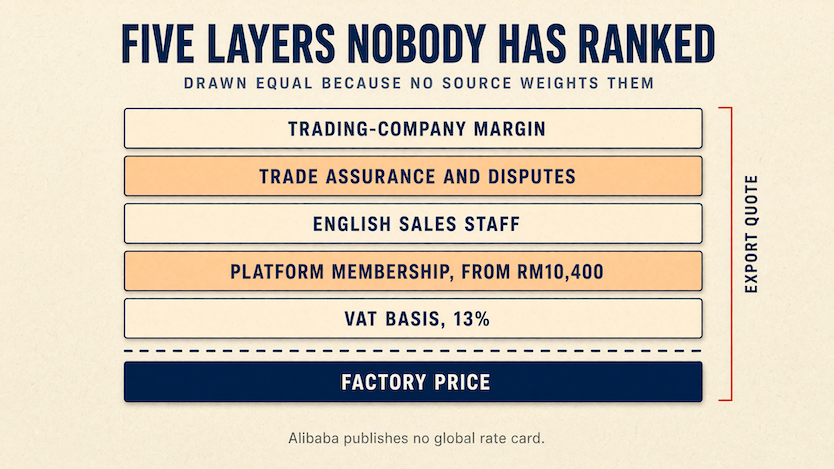
The layers are drawn at equal thickness on purpose. The mechanisms are documentable, but no source ranks them, so any weighting would be invented. · alt: Five equal-thickness cost layers stacked on a factory price, VAT basis, platform membership, English support, Trade Assurance and trading-company margin, turning it into an export quote.
How do you compare a 1688 price against an Alibaba quote?
Seven steps, and the first two are where most comparisons break. A 1688 listing price and an Alibaba.com quote are not the same kind of number: one is usually VAT-inclusive at a quantity tier, the other is an export quote at an MOQ band.
Since no published percentage survives scrutiny, the only figure worth trusting is one you generate. This takes an afternoon on a real SKU and it is the single most useful thing in this article.
- Fix the specification before you fix the platform. Same material, same dimensions, same certification requirement, written down. Most of the apparent price gap in casual comparisons is two different products.
- Match the quantity, not the MOQ. 1688 prices step down by quantity tier and Alibaba quotes by MOQ band. Compare the price each platform gives you at *your* order size, not the headline.
- Establish the tax basis before you compare anything. Ask the seller in writing: “does this price include the 13% VAT special invoice?” (这个价格含13%增值税专用发票吗?) 1688’s own guidance says most suppliers quote ex-VAT by default and add 6–13% if you want the invoice, so stripping 13% from a price that never contained it invents a gap in the opposite direction.
- Establish what each seller actually is. Send both sellers the same two questions, word for word: “What else do you manufacture?” and “Which machines do you run in your own factory?” If the Alibaba seller turns out to be a trading company, you are comparing a factory price to a reseller price, which is the real arbitrage, not a platform difference.
- Price the route to your door, not to the port. For 1688 that means adding a forwarder’s consolidation, export declaration and freight; for Alibaba it may already be quoted FOB or DDP. Our 1688 shipping guide has published carrier rates to work from.
- Add the intermediary cost honestly. If buying from 1688 requires an agent, their fee belongs in the comparison, and on small orders it can exceed the saving entirely, as the published fee schedules in buying from 1688 without an agent show.
- Add duty and clearance for your market. Post-de-minimis in the US and post-€150 relief in the EU, this is no longer a rounding error on small consignments.
| What you will usually find On a like-for-like spec at your real quantity, the gap narrows a long way from the percentages the blogs quote, and on small orders it can close entirely once the agent fee and per-parcel freight are counted. The gap widens again with volume, because the intermediary costs are largely fixed and the price advantage is per unit. That crossover, not a headline percentage, is the number that should decide your channel. Last reviewed August 2026. |
|---|
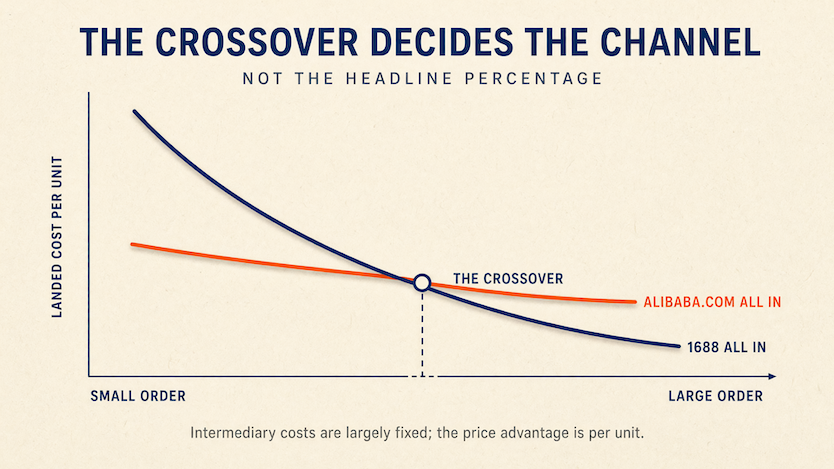
An illustrative shape, not measured data. On small orders the agent fee and per-parcel freight can close the gap entirely; it widens again with volume because the intermediary costs are largely fixed. · alt: Two landed-cost curves crossing as order size grows: the 1688 route starts more expensive on small orders and becomes cheaper with volume.
The most-watched video says avoid 1688. Is it still right?
Partly. Sourcing with Kian’s *1688 vs Alibaba: the TRUTH about 1688.com* has 173,977 views and is the default answer to this question. It was published on 25 August 2020, and of its seven objections, two have since changed, three still stand, and two do not survive a careful look at the video itself.
It is the most-cited artefact on this topic and it deserves a fair hearing rather than a dismissal: much of it was correct when it was made. But it is nearly six years old, and the parts that have expired are the parts people still quote. Metrics below are as displayed on 9 August 2026 (173,977 views, 7,168 likes, 372 comments, channel 68.5K subscribers) and drift over time.
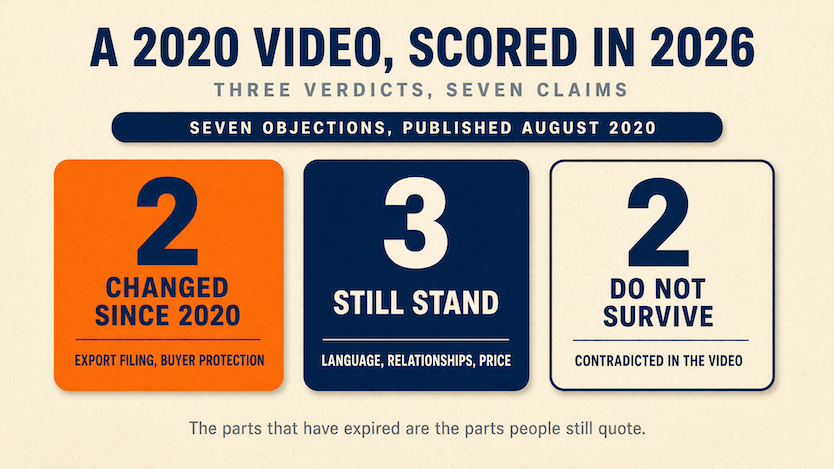
Published 25 August 2020. Much of it was correct when it was made; the export-licence objection was overtaken in December 2022 and buyer protection has since been codified, though capped. · alt: The seven objections in the most-watched 1688 video scored in 2026: two have changed, three still stand and two do not survive a look at the video itself.
| # | The objection | Verdict | Why |
|---|---|---|---|
| 1 | Language barrier | Still true, mostly | 1688, kj.1688.com and global.1688.com all render Chinese-only. But six years of translation improvement and 1688’s image search route around the text entirely |
| 2 | Quality standards are lower | Never true as argued | This conflates platform with product: compliance is a spec-and-supplier question. He also concedes Alibaba middlemen have 1688 factories build the goods, which cannot both be true |
| 3 | 1688 suppliers have no export licence | Changed decisively | On 30 December 2022 China’s NPC Standing Committee deleted the foreign-trade-operator filing requirement from the Foreign Trade Law, and MOFCOM stopped processing it |
| 4 | No payment protection | Changed, with nuance | 1688 now has a codified buyer-protection scheme, but capped at 5% / ¥3,000, domestically framed, and silent on whether overseas buyers qualify |
| 5 | You can’t build relationships | Still true, but weak | Directionally right and unchanged, yet relationships are built through an agent, WeChat and repeat orders on either platform. Not platform-specific |
| 6 | You might not even get a better price | Still true, and the strongest | Six years on, nobody has published a price comparison with a disclosed method. His scepticism has never been falsified |
| 7 | 1688 gives you nothing Alibaba doesn’t | Overstated, he raises the arbitrage himself | At 10:00 he answers with four grounds, then at 10:48 describes the arbitrage, before arguing it disappears “if you just order from alibaba correctly” |
Objection 3 is the one that has genuinely expired, and it deserves both halves of the story. On camera at 05:55 he says that to export from China you need an export licence “which 1688 suppliers don’t have because they’ve never needed it.” On 30 December 2022 the NPC Standing Committee amended the Foreign Trade Law to delete Article 9’s filing provision, and MOFCOM confirmed that from that date provincial commerce authorities stopped processing the registration. Two caveats keep this honest: even in 2020 it was a record-filing rather than a hard-to-obtain licence, and abolishing it does not mean a domestic seller will handle the export declaration, VAT invoicing or the rebate. The legal barrier is gone; the operational one is not, which is why getting 1688 goods shipped still usually needs a forwarder.
| The argument he raises, then waves away At 10:48 he sets out the arbitrage himself. Alibaba middlemen, he says, “are not factories”: they take your order, have it made by a factory on 1688, and resell it with a margin on top, which is why buyers are drawn to 1688 in the first place. Then comes the qualifier that decides how this objection should be graded: “however if you just order from alibaba correctly you never have to go through that process”. Quoted from the auto-generated caption track, which is unpunctuated. That rebuttal is fair as far as it goes: a skilled buyer can screen out trading companies on Alibaba. It is also the whole difficulty: identifying a factory from a listing is exactly the skill a first-time buyer does not have. |
|---|
His own comment section is split, which is worth knowing if you have only seen the video. The single highest-liked comment on it is dissent: “i feel like he doesn’t want us to buy from 1688…. but i do and its amazing” (52 likes), followed by “I have ordered from 1688 many time and have never had a problem” (18). Another commenter, at 14 likes, pushes back on the alternative: “Alibaba Trade Assurance is only WORDS… I personally tried to use it before after my order was paid for and was not shipped for months.” These are anonymous self-reported experiences, not verified incidents, but the reception was never one-sided.
Which platform actually verifies its suppliers?
Both do, and neither verifies what buyers think. Alibaba’s Verified Supplier uses SGS, Intertek and TUV Rheinland; 1688’s top tier costs from ¥106,800 a year and includes a deep on-site audit. Neither certifies your product complies with anything.
Alibaba.com is clear about what its badge means: to qualify as a Verified Supplier, “a supplier’s company profile, production capabilities, products and process controls have to be inspected, assessed and verified by independent third party institutions”, naming SGS, Intertek and TUV Rheinland. Gold Supplier, by contrast, is a paid membership tier receiving only an “A&V and on-site Check”.
1688’s equivalents are also paid, and also tiered: China TrustPass is a storefront and marketing subscription rather than an audit; Powerful Merchant adds third-party document review plus an on-site inspection from ¥36,800 a year; Super Factory adds a deep factory audit from ¥106,800. The reading is the same on both platforms: a badge at the top tier is strong evidence of a real audited factory, and its absence is weak evidence of anything.
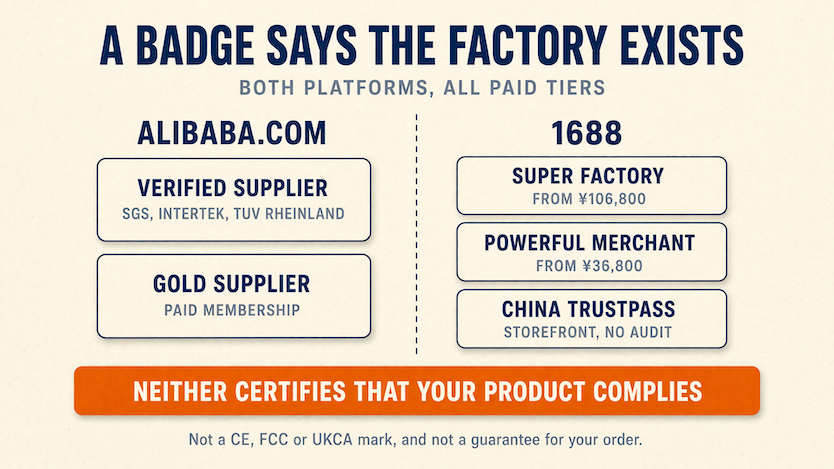
A badge at the top tier is strong evidence of a real audited factory, and its absence is weak evidence of anything. The check that protects a specific shipment is a pre-shipment inspection. · alt: Paid supplier verification tiers on Alibaba.com and 1688 side by side, with a note that neither certifies product compliance.
| What no badge on either platform means Verified Supplier certifies that the company and factory exist and can produce. It is not a CE, FCC or UKCA certification, not a product-compliance mark, and not a quality guarantee for your specific order. Buyers routinely read it as all three. The check that actually protects a specific shipment is a pre-shipment inspection, at $300–$320 per man-day. |
|---|
| It is only a trade-off while the two columns stay apart Everything above says the same thing in different units: 1688 has the price, Alibaba.com has the English, the escrow that names you, and the seller who can legally export. Choosing means giving one of them up, unless something supplies the second column on top of the first. Yakkyofy’s 1688 integration is that: 1688 listings, English interface, image search, your own currency, and a warehouse in China that checks and ships. The public catalogue is the fastest way to test the claim rather than take it: the ¥ source price and the converted price sit on the same row, so you can put a SKU against an Alibaba quote in about a minute. |
|---|
1688 vs Alibaba: so which should you actually use?
Alibaba if the order is large, custom or unrepresented; 1688 if it is small, repeat and you have someone in China. The deciding factor is not the 15–30% people quote. It is whether a 5% payout capped at ¥3,000 is adequate recourse for the money you are sending.
| Your situation | Use | Because |
|---|---|---|
| First order, no China representation | Alibaba.com | Trade Assurance and English support are worth more than the price gap when you have no recourse |
| Custom-spec or tooled product | Alibaba.com | Export-oriented suppliers are set up to quote, sample and certify to a foreign spec |
| Small, repeat, in-stock SKUs | 1688 | Lower minimums and tiered pricing suit restocking; see 1688 MOQ |
| Large order, five figures and up | Alibaba.com, or 1688 with an inspection | The buyer-protection cap becomes irrelevant at that size: your protection is the inspection, not the platform |
| You already have an agent, forwarder or platform | 1688 | The friction that makes Alibaba worth its markup is the friction they are already absorbing |
The two platforms are not really competing on price. They are competing on how much of the work you have to do.
The third option is to buy at 1688 prices without doing 1688’s work: no Chinese-only search, no verified mainland Alipay account, no forwarder and no export declaration. Yakkyofy, which publishes this guide, connects to 1688 directly and acts as the buyer of record, so the price you see is the all-in one: converted to your currency before you commit, English and image search, a pre-shipment check at its Dongguan warehouse, and consolidated worldwide shipping, from a single unit.
| Settle it on your own product: price the same SKU on both platforms at your real quantity, with the 1688 side converted into your currency, goods and handling included, duty and clearance still on top, for either channel. ➜ Price your product free |
|---|
Yakkyofy handles 1688 sourcing, consolidation, quality checks and duty forecasting from a single unit up, so you don’t need to solve these problems yourself.
Frequently asked questions
Is 1688 cheaper than Alibaba?
Generally yes, but nobody has published a measurement. Every figure in circulation (4–15%, 15–30%, a single-SKU example implying 44%) comes from a company with something to sell and none discloses a sample size, date or comparison rule. WorldFirst’s own *1688 vs Alibaba* page answers the question with “Sometimes, yes and sometimes no.” Model your own basket and compare landed cost, not list price.
Are 1688 and Alibaba the same company?
Same parent, different businesses. Both belong to Alibaba Group, but in the FY2026 Form 20-F 1688 is reported under China commerce wholesale inside Alibaba China E-commerce Group while Alibaba.com sits in international commerce wholesale in a separate business group. Different buyers, different languages, different payment rails, and in FY2026 the two lines finished within RMB 130 million of each other, at RMB 26,312 million and RMB 26,439 million.
Why is 1688 cheaper if it is the same suppliers?
Several reasons, none cleanly weighted. China’s 13% VAT is usually inside a domestic 1688 price and stripped from an export quote, so part of the apparent gap is an accounting artefact. Alibaba suppliers carry membership costs (one official channel partner lists Gold Supplier from RM10,400 a year) plus English sales staff and Trade Assurance overheads. And a share of Alibaba listings are trading companies reselling 1688 factories.
Is the 1688 vs Alibaba video from Sourcing with Kian still accurate?
Partly. Published in August 2020, two of its seven objections have since changed: the export-licence argument was overtaken when China deleted the foreign-trade-operator filing on 30 December 2022, and 1688 has since introduced a codified buyer-protection scheme, albeit one capped at 5% of the order and silent on overseas buyers. Two more do not survive a careful look at the video itself, including the “nothing Alibaba doesn’t give you” claim, where he describes the arbitrage himself 45 seconds later. Its scepticism about the price gap has held up best.
Does 1688 have Trade Assurance?
No. Trade Assurance is an Alibaba.com programme. 1688 runs Alipay escrow and a buyer-protection scheme paying 5% of the order capped at ¥3,000, and only ¥500 on its genuine-factory guarantee, but the agreement is silent on whether overseas buyers qualify, and there is no cross-border arbitration. For real order sizes, a pre-shipment inspection is the meaningful protection.
Should a beginner use 1688 or Alibaba?
Alibaba.com, unless you already have someone in China. A first-time buyer with no agent, no forwarder and no Chinese-language capability is paying Alibaba’s premium for exactly the things they cannot yet do themselves: English support, an export-ready supplier, and a dispute process. 1688 becomes the better choice once that infrastructure exists, or once a platform provides it for you.


