
Five ways to pay a 1688 supplier from outside China, priced from 1.6% to 50% of the same $200 order, and the one requirement almost every guide gets wrong.
You have already done the hard part. You found the supplier, worked out the price, and reached a checkout that will not take your money. That is what how to pay on 1688 without Alipay means in practice: 1688 is Alibaba Group’s domestic Chinese wholesale marketplace, and its payment layer was built for buyers who already hold Chinese accounts, so the last step of a working order is the one that fails.
The good news is that this is less true than it was two years ago. The bad news is the shape of the answer: you can now avoid a Chinese bank account, and on at least one on-platform route you can avoid a mainland-registered Alipay account as well, but not on the cheapest one. This guide prices every route honestly, including the ones that do not involve us, and is explicit about what each leaves you exposed to.
| Skip the rails entirely: an all-in 1688 price already converted to your currency, paid the way you normally pay, from a single unit. → See the all-in price ➜ See how it works |
|---|
Can you pay on 1688 without Alipay?
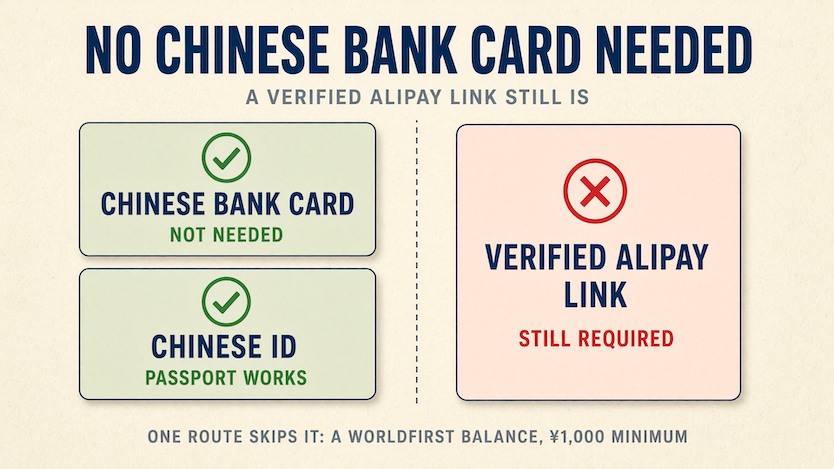
Partly. It depends which route. World Pay, at roughly 1.6% all-in, requires your 1688 account linked to a mainland-registered Alipay account; WorldFirst says so itself. But it documents a second on-platform route, paying from a WorldFirst balance, which it states needs no Alipay account, with a ¥1,000 minimum.
Two categories of payment, not five. That distinction is the single most important thing on this page:
- On-platform. The 1688 order is marked paid, the supplier is paid through 1688’s system, and there is a transaction record. World Pay requires a verified mainland Alipay account; WorldFirst’s own documentation lists no Alipay requirement for the card route or for paying from a WorldFirst balance.
- Off-platform. You send money to a bank account or a wallet (a supplier’s, an agent’s, or a friend’s) and the 1688 order is never settled inside the platform at all. Cheaper in fees, and materially worse if anything goes wrong.
WorldFirst (owned by Ant Group, the company that operates Alipay) states the requirement in its own help centre, listing “your 1688.com account is not linked to an Alipay account registered in Mainland China” as a reason World Pay will not appear at checkout. When the company selling you the alternative to Alipay says its own product needs an Alipay link, that part is settled, but it scopes that requirement to World Pay, not to its other two routes.
| What this means for the search you just ran If “without Alipay” means “without a Chinese bank card,” you are in luck. A foreign passport is enough to verify an Alipay account, and a foreign Visa or Mastercard can fund it. If it means “without any Alipay account at all,” you are down to the WorldFirst balance route or an off-platform transfer. Read the risk section before choosing. |
|---|
Why does 1688 insist on Alipay in the first place?
Because 1688 was never built for you. Alibaba Group’s own corporate description calls it China’s domestic wholesale marketplace, with no mention of international buyers or an English version, and Chinese suppliers must file each overseas receipt with the foreign-exchange regulator within 5 days, which a domestic wholesaler has never registered to do.
Three structural things follow from that, and they explain most of the friction people run into:
- Settlement is domestic by design. Suppliers are paid in RMB into Chinese accounts. A former Alibaba employee put it this way on Reddit: “1688 is B2B for China to China, payment is via local banking or Chinese Alipay pegged to a local bank account, even if you get an account it’s incredibly hard to make payments because most of the vendors have no way to accept international payments.”
- A foreign wire is not a simple wire. Chinese beneficiaries must be registered with the State Administration of Foreign Exchange to receive funds from overseas, and must file documentation with the regulator within five days of each receipt. A purely domestic wholesaler has never registered for this and has no capacity to file it, which is why wires to 1688 sellers get rejected or stranded rather than merely delayed.
- Some suppliers actively prefer to stay off the books. One importer with four years of China entity experience explained the incentive directly: “the reason your supplier is asking for payment in a personal account is to save 13% VAT. If you pay officially through a bank transfer, they are required to issue a commercial invoice, which results in additional tax.” Convenient for them, and a problem for you the moment you need a document trail.
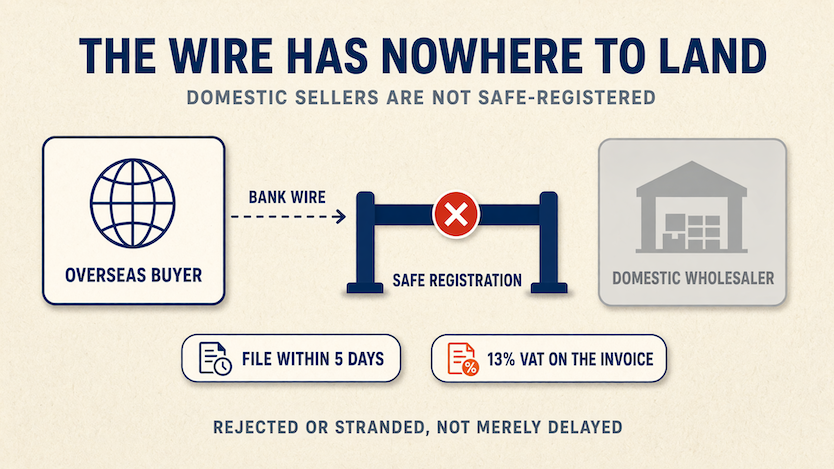
Chinese beneficiaries must be registered with the State Administration of Foreign Exchange to receive funds from overseas, and must file documentation within five days of each receipt. A domestic wholesaler has never registered for either. · alt: Diagram showing why a foreign bank wire to a 1688 supplier fails: the domestic wholesaler is not registered with China’s foreign-exchange regulator.
What does Alipay real-name verification actually require?
A passport is accepted: a Chinese national ID is not required. Since a 2023 service upgrade, Alipay accepts six overseas document types for real-name verification, including passports, Hong Kong/Macau and Taiwan travel permits, and foreign permanent-residence cards. The step that actually blocks people is the phone number, not the ID field.
This is the screen people hit and assume is the end of the road, because it is presented in Chinese and asks for an ID number in a field that looks Chinese-only. It is not. The verification flow asks for four things:
| Field | As it appears on screen | What a foreign buyer supplies |
|---|---|---|
| Real-name verification | 实名认证 | The gate itself, mandatory before any payment or card binding |
| Document type | 证件类型 | Choose passport rather than the default Chinese ID |
| Document number | 证件号码 | Your passport number |
| Mobile number | 手机号码 | The account registration step: the most common point of failure for foreign numbers |
The step that genuinely blocks people is not the ID field but the phone number, and it blocks them before they ever reach payment. Buyers report account creation being refused outright: “I’ve been trying to make an account on Taobao with a U.S. number and it says they are not serving the area. I tried to make an account with 1688 directly, and I’m having the same issue.” Another described the process as “inconsistent if you are not in Asia, as they primarily designed for the Chinese domestic market.” Threads reporting this were still active in August 2026.
| Sequence matters Create and verify the Alipay account before you try to check out, not after. If the account is not linked and verified, the payment options simply do not appear at 1688 checkout, and the usual conclusion people draw is that their card was rejected, when in fact it was never offered. |
|---|
Can you pay 1688 with a credit card?
Yes, for many sellers: the part most guides have not caught up with. International Visa and Mastercard are accepted at a 3% fee. Ant Group raised its cross-border card limits to US$5,000 per transaction and US$50,000 a year in March 2024, up from US$1,000 and US$10,000. Ant framed that change around overseas visitors spending inside China rather than around 1688 checkout, so treat the ceilings as the platform limits they are, not as a published 1688 allowance.
You will still find widely-cited tutorials stating flatly that foreigners can only pay with an Alipay balance or a mainland bank card. Those pages predate the rollout. WorldFirst’s own regional help centres document the card option and put the fee at 3%, while marketing a competing product, which makes it an unusually credible source. Alipay’s service agreement for the 1688 platform lists 国际支付 (international payment) as a supported instrument class, though it publishes no rate. And buyers confirm it works in practice: “Yep. Paid in January with visa”; “They’ve had this option for over a year. I’ve used it”; “I recently purchased using a foreign debit card.”
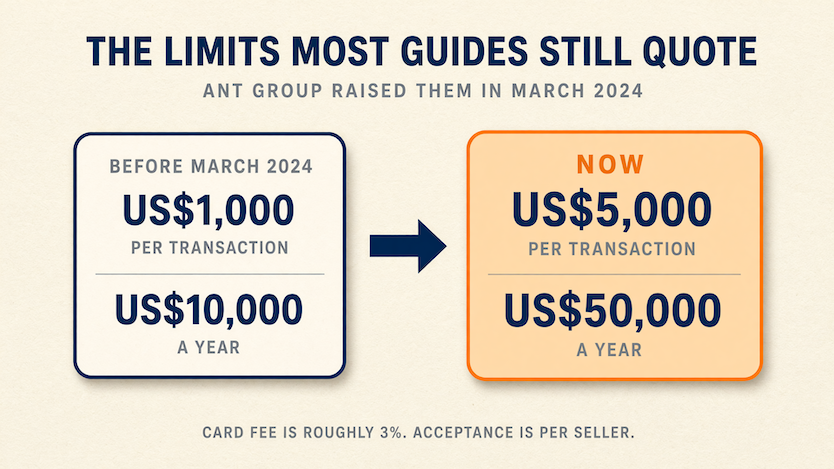
Ant framed the March 2024 increase around overseas visitors spending inside China rather than around 1688 checkout, so treat these as platform limits, not a published 1688 allowance. · alt: Ant Group’s cross-border card limits before and after March 2024: US$1,000 per transaction and US$10,000 a year raised to US$5,000 and US$50,000.
Three caveats, all of which matter more than the fee:
- Acceptance is per-seller, not platform-wide. Asked whether there is a surcharge, buyers answer “it depends on the seller,” and some report sellers adding their own fee on top. Nobody in the public record has quantified that surcharge.
- No 1688-specific ceiling is published. The old “cards fail above a few hundred dollars” complaint matched the pre-March-2024 US$1,000 per-transaction cap, which no longer applies, but neither Ant nor WorldFirst publishes a per-transaction ceiling for 1688 checkout specifically. Assume one exists and test with a small order before committing a large one. Issuing banks also still decline China-bound transactions on their own risk rules.
- Paying does not mean shipping. A supplier who takes your card will still ship only to a Chinese address. Solving payment solves exactly one of the two walls.
Is there an official international version of 1688?
Not on the web, and probably not in your market. Two cross-border surfaces exist, kj.1688.com and global.1688.com, but both are sourcing tools aimed at Chinese exporters, and neither offers international payment to a foreign buyer. A separate 1688 Global app runs in some Asian markets.
This matters because a lot of advice assumes an English 1688 exists somewhere and you simply have not found it. Checked in August 2026: the cross-border channel describes itself as a supply platform serving Chinese export sellers on AliExpress, Amazon and Wish, and its navigation contains sourcing, supplier-vetting and seller-onboarding entries with no consolidation or international-logistics product anywhere in it. Alibaba Group’s own corporate description of 1688 makes no mention of international buyers, cross-border services or an English version at all.
You will also see references to a separate overseas platform, 1688Overseas or 1688 Global. That one is real, but it is not a web storefront: Alibaba publishes 1688 Global as a mobile app offering localised language, local payment and local logistics, rolled out across Southeast and Central Asia: Vietnam, Kazakhstan and Uzbekistan among them. It is a distinct platform with its own supplier pool, not the 1688 you are browsing, and availability is market-by-market with no Western rollout as of August 2026. If you are buying from the US or Europe, assume the routes below still apply, and that translation plus image search is how the platform is navigated.
What are all the ways to pay a 1688 supplier from outside China?
Five routes, and the cheapest published rate, WorldFirst’s 0.8%, is unavailable to anyone without a registered business. For an individual buyer the realistic floor is the 3% card fee; for a company it is closer to 1.6% all-in once platform and FX charges are counted.
| Route | Published cost | Setup | Settles the 1688 order? | Who it suits |
|---|---|---|---|---|
| International card at 1688 checkout | ~3% surcharge | Verified mainland Alipay account | Yes | Individuals and small buyers with no company |
| WorldFirst balance in foreign currency | Fee not published; ¥1,000 minimum order | Verified WorldFirst and 1688 accounts: WorldFirst states no Alipay account is required | Yes | Companies already holding a WorldFirst balance who cannot get an Alipay link |
| WorldFirst World Pay | Up to 0.8% + up to 0.2% platform fee + up to 0.6% FX ≈ 1.6% all-in | Business onboarding: company registration number, director ID, UBO details. No personal accounts exist | Yes | Registered companies and sole traders paying at volume; no annual FX ceiling |
| A friend or relative’s Alipay in China | Nominally free; real cost is the favour and the exposure | None, if you have the relationship | Yes, but in their name | Nobody, commercially. See the risk section |
| Off-platform transfer (Wise, bank wire, PingPong) | Wire ~US$45 plus FX spread; Wise quotes live per corridor | Recipient must be an eligible Chinese individual or a SAFE-registered business | No | Paying an established supplier you already trust, on repeat business |
| A commission agent | 0% to 15% published, depending entirely on the agent and order size | Finding one you trust: the real cost | The agent’s order, not yours | Irregular or bespoke buying where negotiation matters |
Two notes on the numbers above, because published fees in this category are less solid than they look. WorldFirst discloses its 1688 rate unevenly across its own sites. Its Singapore pricing page publishes 0.8% for payments to 1688.com and TaoWorld, plus a currency-conversion margin of up to 0.6%, its mainland Chinese FAQ says 0.4% (Chinese-language), and its global and EU help centres decline to publish a figure at all, directing you to the dashboard for a quote. And on the agent side, published schedules range from zero (Superbuy charges no service fee on 1688; BuckyDrop advertises ¥0 and “0% markup”) to 15% on Leeline’s published table for orders between $500 and $1,000, with a $100 flat fee below $500. Published schedules are far wider than the “5–10% typical” figure that circulates, so treat any single “typical” percentage as an opening position rather than a market rate.
One route the search term suggests but that we would steer you away from: PayPal. There is no PayPal path into 1688 checkout, and a supplier who offers to take PayPal “as a friend” is asking you to waive buyer protection on a wholesale order.
What does the payment layer actually cost on a real order?
$3.20, $6.00 or $100.00, same $200 order. That is World Pay at ≈1.6%, an international card at 3%, and an agent charging Leeline’s published flat minimum, which works out at 50% of the order. On a $2,000 order the gap narrows sharply, because commission scales and fixed fees do not.
The route that is cheapest at volume is the most punitive at test quantities: the opposite of what a new seller needs, and percentages hide it. Below are the same two orders run through each route using the rates published above, payment fees only: no freight, duty or supplier-side surcharge. Read the shape, not the exact figure.
| Route | Fee on a $200 order | Fee on a $2,000 order | Effective rate at $200 |
|---|---|---|---|
| WorldFirst World Pay (≈1.6% all-in) | $3.20 | $32.00 | 1.6%, but company required |
| International card (3%) | $6.00 | $60.00 | 3.0% |
| Bank wire (≈$45 flat, plus FX spread) | $45.00 | $45.00 | 22.5% |
| Commission agent, Leeline published schedule | $100.00 (flat minimum, under $500) | flat $100 applies to any order under $500; the 15% band runs $500 to $1,000, at this size | 50.0% |
| How to read this Fees are calculated from each provider’s published rate in August 2026 and exclude freight, duty, FX movement and any surcharge the supplier adds. Leeline’s own two published tables disagree on some tiers. Leeline publishes a $100 flat minimum below $500 and 15% between $500 and $1,000, then a continuous ladder that tapers to 4.0% above $100,000. The figures above use its 1688-agent page. Rates change without notice. Confirm before you commit. Last reviewed August 2026. |
|---|
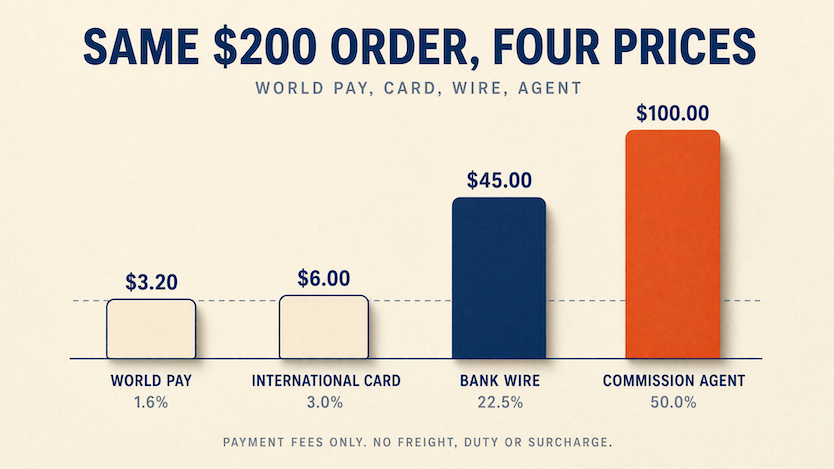
Payment fees only, calculated from each provider’s published rate in August 2026. Freight, duty, FX movement and any supplier surcharge sit on top. The agent figure is Leeline’s published $100 flat minimum below $500. · alt: Bar chart of payment fees on the same $200 1688 order: $3.20 on World Pay, $6.00 by international card, $45.00 by bank wire and $100.00 through a commission agent.
How do you pay a 1688 supplier, step by step?
Six steps, in this order. Verification comes before checkout and a forwarder’s address before payment, because once a supplier with no valid Chinese delivery address has been paid, you own goods you cannot collect. Budget roughly 3% if you are paying by card.
- Register an Alipay account and complete real-name verification with your passport. Select 护照 as the document type. Expect the mobile-number step to be the awkward one.
- Link that Alipay account to your 1688 account. Both personal and corporate 1688 accounts qualify. Without this link, no international payment option appears at checkout.
- Get your freight forwarder’s Chinese warehouse address before you order, and enter it as the delivery address. The supplier ships domestically to that warehouse; the forwarder consolidates and exports.
- Confirm the supplier will accept your payment method before you commit. Acceptance is per-seller, not platform-wide. Send one message and ask all three: do you accept international card payment at 1688 checkout, do you add a surcharge on top, and will you ship to my forwarder’s warehouse address in China? Several sellers do add a surcharge, and nobody in the public record has quantified it, so get the number from the seller before you pay, not after.
- Pay through a route that settles inside 1688, card or World Pay. If you are being handed a QR code to an individual’s wallet, stop and read the next section first.
- Keep the platform transaction record. 1688 does run its own refund and dispute process, but it operates in Chinese, is built for mainland buyers and sellers, and applies only to orders actually settled inside the platform. The record is the precondition for any recourse at all.
What does each payment route NOT protect you from?
All of them, from roughly the same thing. 1688 does run an escrow: a secured-transaction mechanism that holds funds until the buyer confirms receipt. What it has no equivalent of is Trade Assurance: the claims process runs in Chinese, assumes a mainland return address, and offers no cross-border arbitration on a quality dispute.
The misconception carried over from Alibaba.com is that the two platforms protect you the same way. They do not. Trade Assurance is an Alibaba.com programme covering export orders placed on that marketplace; 1688’s machinery is domestic, Chinese-language and built around a mainland buyer with a mainland return address. A buyer in r/1688, asked directly in July 2026, answered: “No, 1688 does not know such as mechanism, as 1688 was originally designed for Trade within Mainland China only.” The same buyer flagged what follows: “most 1688 Agents will give you QR Code to their personal wallet (not business account).”
- Card at checkout gives you a platform record and, separately, a chargeback right with your issuer: the strongest position available to an individual buyer, though chargebacks on international wholesale are slow and contested.
- World Pay runs through 1688’s secured-transaction escrow and puts a regulated payments company in the chain, but there is no cross-border arbitration of quality disputes.
- A friend’s Alipay puts the order in someone else’s name. If it goes wrong, the counterparty is your friend, not you, and you have created a personal obligation around a commercial loss.
- Off-platform transfer leaves no 1688 record at all. The order is not marked paid, escrow does not apply, and you are relying entirely on the supplier’s goodwill.
- An agent substitutes their relationship for your protection. That can work well and often does, but the exposure is now to the agent’s solvency and honesty. Get the fee schedule in writing before the first order: published schedules run from 0% to 15%, and a flat minimum like Leeline’s $100 is a 50% payment fee on a $200 order, before anything ships.
The practical substitute for escrow is a pre-shipment inspection, at $300–$320 per man-day through a third-party firm. It costs more than the payment fee and prevents a far more expensive problem, since returning defective goods to China routinely costs more than the order is worth. Our guide to arranging quality control directly in China covers how that is booked.
| Every route above is a way of becoming a Chinese buyer That is the pattern running through the whole table: real-name verification, a Chinese bank account, or a proxy who pays on your behalf. Six answers to one question, each adding a layer that has to be paid for. The remaining option never asks the question. Yakkyofy’s 1688 integration settles the 1688 side and bills you in your own currency on your own card: no Alipay account, no passport upload, no proxy holding your money in between. The public catalogue shows the conversion in the open: the ¥ the seller quotes and the figure you actually pay, on the same row. |
|---|
Which payment route fits which kind of seller?
Below roughly US$5,000 an order with no company, the card is the only official route open to you. With a registered business and steady volume, World Pay is cheaper at about 1.6% all-in. Above that, the question stops being payment and becomes consolidation.
| Your situation | Route that fits | Why |
|---|---|---|
| Testing products, no company yet | International card | World Pay onboarding requires a company registration number; there is no personal path |
| Registered business, regular orders | WorldFirst World Pay | ≈1.6% all-in beats 3%, and there is no annual FX ceiling |
| Single order above US$5,000 | World Pay, or split the order | The card rail is capped per transaction |
| Irregular, bespoke, negotiated buying | Commission agent | You are buying negotiation and relationship, not a payment rail |
| Repeat SKUs, want one process end to end | Direct-access platform | Payment, conversion, inspection and freight handled as one workflow |
That last row is what Yakkyofy does, and it is worth being precise about how it differs. Rather than giving you a rail to pay a Chinese supplier, it removes the rail from your side of the transaction entirely: you see an all-in price already converted to your currency, pay the way you normally pay, and Yakkyofy settles in RMB with the supplier, runs a pre-shipment check at its Dongguan warehouse and ships worldwide. Orders are supported from a single unit, which matters here because the card rail is the only other option open to a seller without a company. See the 1688 integration, or the pricing page for current tiers.
Payment is only the first of two walls. Once the supplier is paid, the goods still have to leave China, which no 1688 seller will do for you. That is covered in does 1688 ship to the USA, and the wider question of which parts of an agent’s job you can replace is in how to buy from 1688 without an agent.
| Paste a 1688 product and see the all-in cost in your own currency, conversion, checks and shipping included, from a single unit. ➜ Price your product free |
|---|
Yakkyofy handles 1688 sourcing, consolidation, quality checks and duty forecasting from a single unit up, so you don’t need to solve these problems yourself.
Frequently asked questions
How do you pay on 1688 without Alipay?
You cannot, if you want the payment to settle inside 1688. WorldFirst’s World Pay requires your 1688 account to be linked to a mainland-registered, identity-verified Alipay account. WorldFirst’s own 1688 guide lists a shorter set for the international-card route: a Visa or Mastercard credit or debit card, a 1688 account, and the card linked to that account. What you can avoid is a Chinese bank card: a foreign passport is accepted for verification and a foreign card can fund the payment. Any other method pays a person off-platform, leaving the 1688 order unsettled and unprotected.
Can I pay 1688 with a credit card?
Yes, with many sellers. International Visa and Mastercard are accepted at roughly a 3% fee, within Ant Group’s cross-border limits of US$5,000 per transaction and US$50,000 per year, raised from US$1,000 and US$10,000 in March 2024. Acceptance is per-seller rather than platform-wide, some sellers add a surcharge, and your issuing bank can still decline China-bound transactions on its own risk rules.
What does WorldFirst World Pay cost for 1688?
WorldFirst’s Singapore pricing page publishes 0.8% per transaction plus 1688’s platform fee of up to 0.2% and FX conversion of up to 0.6%, roughly 1.6% all-in. Its mainland Chinese FAQ publishes 0.4% instead, and its global and EU help centres decline to publish a rate at all, directing users to the dashboard. Treat the rate as region-dependent and confirm it before committing. World Pay requires a registered company or sole trader; there is no personal account.
Can I use Wise or PayPal to pay a 1688 supplier?
Neither settles a 1688 order. Wise can send CNY to a Chinese recipient’s Alipay or bank account, but the recipient must be a mainland Chinese citizen or a Hong Kong/Macau resident and the money lands outside 1688, so the order is never marked paid and no escrow applies. There is no PayPal route into 1688 checkout at all.
Is it safe to pay a 1688 supplier through a friend’s Alipay account?
It works mechanically and it is a poor commercial arrangement. The order sits in your friend’s name, so any dispute, refund or quality claim is theirs to pursue rather than yours, and you have attached a personal relationship to a commercial risk. 1688’s own secured-transaction escrow applies to the order in their name, not to your arrangement with them, so the route you choose is largely a question of evidence rather than protection.
Does 1688 have buyer protection like Alibaba Trade Assurance?
Not in a form a foreign buyer can rely on. Trade Assurance is an Alibaba.com escrow scheme and has no equivalent on 1688. 1688 does run its own secured-transaction escrow, and a refund and dispute process behind it, but both are Chinese-language, designed for mainland trade, and apply only to orders settled inside the platform, never to an off-platform transfer. The practical substitute is a third-party pre-shipment inspection at roughly $300 per man-day, booked before the goods leave China, because once defective goods have been exported, returning them usually costs more than the order is worth.


