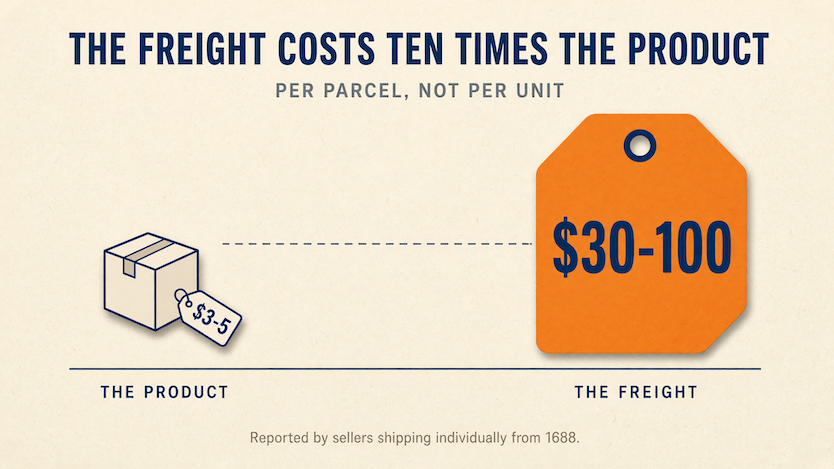

1688 suppliers ship to Chinese addresses only. Sellers shipping individually report freight of $30–100 a unit on a $3–5 product. Here is the four-leg route that actually gets goods to the United States, what it costs on published carrier rates, and how long it really takes.
The short answer to does 1688 ship internationally is no, and it is worth being clear about why before looking at workarounds. 1688 is Alibaba Group’s domestic Chinese wholesale marketplace. Its sellers quote domestic delivery, arrange domestic couriers, and in many cases hold no customs registration at all, so international carriage is not a service they are declining to offer, it is one they are not set up to provide.
Get the order of operations wrong and you end up with paid-for goods sitting in a Chinese warehouse with no way to move them: the route that works is not complicated, but it has a specific shape. A buyer importing 400 units to the Gulf put the constraint in one sentence in August 2026: “1688 only ships within China and doesn’t support international shipping or foreign payment directly.” Below: the four legs and who owns each, DHL’s published ¥505 at 0.5 kg against the US$31 benchmark for the same parcel, the transit times behind 59.0–64.7% schedule reliability, and what the end of $800 de minimis changed at the US border.
| Per-parcel shipping is what destroys the 1688 price advantage. Consolidation, pre-shipment checks and worldwide delivery under one account, on many products from a single unit. → See your landed cost ➜ See how fulfilment works |
|---|
Does 1688 ship internationally?
No. 1688 suppliers deliver to Chinese addresses only, and the platform operates no international consolidation service. The working route is to give the supplier a freight forwarder’s warehouse address inside China, then have the forwarder consolidate, declare and export the shipment.
1688’s cross-border surfaces are built for Chinese merchants, not for you. They exist, kj.1688.com and global.1688.com, and kj.1688.com does carry logistics in its navigation: overseas fulfilment sits alongside a global-factory channel, and Cainiao’s cross-border service bundles collection, international transport, clearance at both ends and destination delivery. But they are export tools sold to Chinese merchants fulfilling their own overseas orders; you cannot point one at a 1688 listing as an overseas buyer.
So the delivery chain has four legs rather than one, and each has a different owner:
| Leg | Who does it | What it costs |
|---|---|---|
| Supplier → Chinese warehouse | The 1688 supplier, by domestic courier | Often free or a few RMB; quoted on the listing |
| Receiving, checking, consolidation | Your freight forwarder | Free storage typically 7–30 days, then storage fees accrue |
| Export declaration | A registered consignor or licensed customs broker | Bundled into the forwarder’s quote |
| China → USA carriage and clearance | Express carrier, air freight or ocean LCL/FCL | The dominant cost. See the rate tables below |
Can your 1688 supplier legally export at all?
Often not, and it is worth asking before you order. Under GACC Order No. 253, a Chinese export declaration can only be filed by a party record-filed with Customs as an import/export consignor or consignee, or by a record-filed customs declaration enterprise acting on its behalf. A purely domestic 1688 wholesaler is usually neither.
China simplified this in December 2022 by abolishing the separate foreign-trade-operator filing, so the picture is less bureaucratic than older guides suggest. But the substantive requirement remains: a company must be registered with Customs, with a business licence covering goods import/export, before it can declare anything. Experienced buyers therefore treat export capability as a screening question rather than an assumption: “you should ask if the suppliers can do export. Please also check if they have required product certificates for your destination country.”
Where a supplier cannot export, the compliant answer is agency export (代理出口 on Chinese paperwork): a licensed foreign-trade agent signs the export contract, declares in its own name, handles the foreign-exchange settlement and charges for doing so. This is normal practice and preserves the export VAT rebate. Your forwarder will usually either provide it or arrange it.
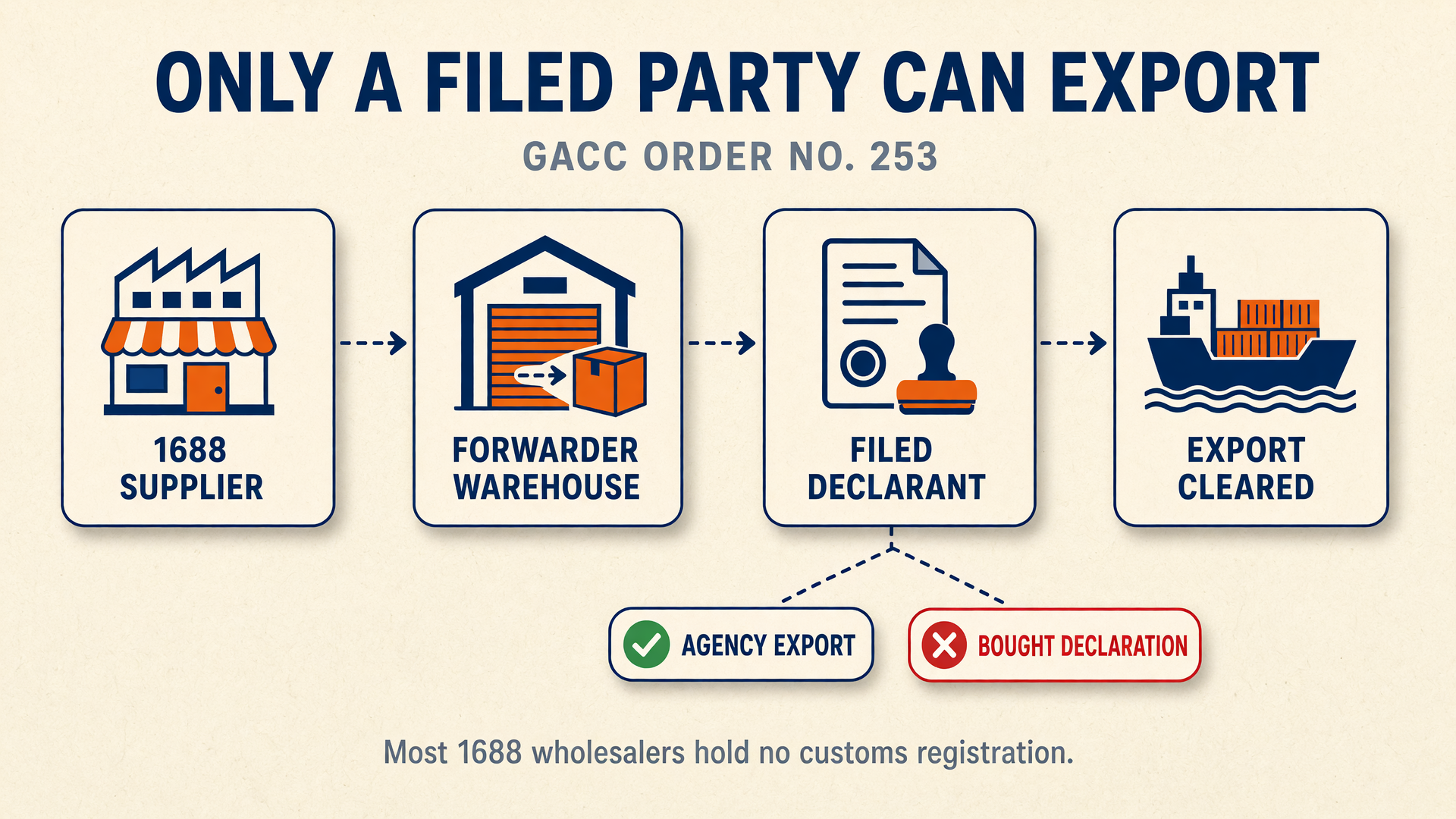
Under GACC Order No. 253 the declarant must be registered with China Customs. Where your supplier is not, agency export (代理出口) is the lawful route and a bought declaration is not. · alt: Only a customs-registered declarant can file a 1688 export: goods move from supplier to forwarder warehouse, then clear through agency export rather than a bought declaration.
| The offer to refuse You may be offered a “bought declaration”, exporting under an unrelated company’s customs documents. It is cheaper because it is unlawful in China: it forfeits the export VAT rebate, breaks the foreign-exchange rules that tie the exporter to the receipt, and raises your inspection rate. It is not the same thing as agency export, and a forwarder who presents them as equivalent is telling you how they will handle your cargo. |
|---|
What does shipping from 1688 to the USA actually cost?
Two prices exist for the identical 0.5 kg parcel: about US$31 through a 3PL’s negotiated DHL account, or ¥505 on DHL’s published 2026 China rate card, which puts the USA in Zone 6 at ¥505 for 0.5 kg and ¥6,549 for 20 kg, before fuel surcharge. Almost nobody pays list.
List rates are a ceiling, not a price. That gap, roughly ¥505 (about US$70 before fuel) against US$31 for the identical service, is the most useful thing to understand about China–US shipping costs, and it is why quoted rates vary so wildly between forwarders: a near-list quote is not a different service, it is a different account.
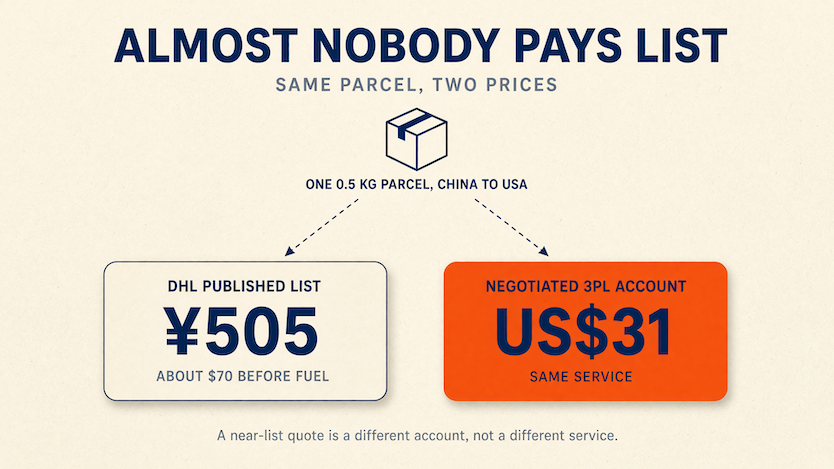
DHL’s published 2026 China rate card puts the USA in Zone 6 at ¥505 for 0.5 kg before fuel surcharge, converted here at ¥7.2/US$ for illustration. The US$31 figure is a benchmark for the same parcel on a 3PL’s negotiated account. · alt: The same 0.5 kg parcel from China to the USA priced at ¥505 on DHL’s published list rate and about US$31 through a 3PL’s negotiated account.
| Billable weight | DHL Express Worldwide, published China → USA (CNY) | Indicative USD before fuel |
|---|---|---|
| 0.5 kg | ¥505 | ≈ $70 |
| 1 kg | ¥670 | ≈ $93 |
| 3 kg | ¥1,323 | ≈ $184 |
| 5 kg | ¥1,959 | ≈ $272 |
| 10 kg | ¥3,549 | ≈ $493 |
| 20 kg | ¥6,549 | ≈ $909 |
| 30–300 kg | ¥279 per kg | ≈ $39/kg |
For heavier consignments the arithmetic changes shape entirely. Indicative air-freight rates on the China–US lane run roughly US$5.68–7.92/kg under 45 kg, falling to US$2.60–3.19/kg above a tonne. Ocean becomes competitive above roughly 500 kg: Drewry’s World Container Index assessed Shanghai–Los Angeles at US$5,894 per 40ft container and Shanghai–New York at US$7,893 in early August 2026. Published LCL pricing is quoted so inconsistently (one forwarder at US$382 per CBM, another at US$80–150) that the number is meaningless without knowing the Incoterm and what is bundled into it.
| Parcel weight | DHL list rate | Approx. USD | Note |
|---|---|---|---|
| 0.5 kg | ¥505 | ≈$70 | Before fuel surcharge |
| 5 kg | ¥1,959 | ≈$272 | Before fuel surcharge |
| 20 kg | ¥6,549 | — | Same list card, before fuel |
DHL’s published 2026 China rate card puts the USA in Zone 6 at ¥505 for 0.5 kg, ¥670 at 1 kg, ¥1,323 at 3 kg, ¥1,959 at 5 kg, ¥3,549 at 10 kg and ¥6,549 at 20 kg, then ¥279 per kg from 30–300 kg, all before fuel surcharge and converted here at ¥7.2/US$ for illustration. The same 0.5 kg parcel routed through a 3PL’s negotiated DHL account has been benchmarked at about US$31. Surcharges compound small shipments: DHL’s US tariff publishes a remote-area fee at US$0.50 per lb with a US$50 minimum, clearance processing at US$15 per shipment and duty-tax processing at 2% of fiscal charges with a US$17.50 minimum. YunExpress and 4PX publish no rate card at all, so any per-kilo figure quoted for them online is unsourced.
On a small 1688 order the surcharges routinely exceed the shipping. DHL’s US tariff publishes a remote-area fee at US$0.50 per lb with a US$50 minimum, clearance processing at US$15 per shipment, and duty-tax processing at 2% of fiscal charges with a US$17.50 minimum.
| On rate cards Every figure in this section is a published list rate or an indicative benchmark, checked August 2026, and varies by lane, season and account. Two carriers that dominate this route (YunExpress and 4PX) publish no rate card at all, and any per-kilo figure you see quoted for them online is unsourced. Get a written quote for your own lane and weight before modelling margin. |
|---|
How long does shipping from 1688 to the USA really take?
Express runs 3–5 business days once it leaves China, and that is the honest easy part. The realistic worst case is far worse than the marketing range: container schedule reliability ran between 59.0% and 64.7% through the first half of 2026, and late vessels arrived an average of 5.2–5.5 days behind.
Most published transit times measure only the carriage leg, which is why they bear so little resemblance to what sellers experience. A realistic door-to-door estimate has to include the parts nobody advertises: the supplier’s own production and dispatch time, the wait at the Chinese consolidation warehouse for a container to fill, the carriage itself, then US clearance.
| Stage | Typical | Realistic bad case | Source of the delay |
|---|---|---|---|
| Consolidation wait in China | 0–3 days | 3–7 days | Cargo arrives after a container is nearly full and waits for the next sailing |
| Express carriage (DHL/FedEx/UPS) | 3–5 business days | 5–7 business days | Economy service variants, remote-area routing |
| Ocean carriage | Nominal schedule | +5.2–5.5 days on average when late, and only ~60% of vessels arrive on time | Sea-Intelligence Global Liner Performance, H1 2026 |
| US customs clearance | 2–5 days | Up to 2 weeks | Wrong HS code, vague commercial invoice, mismatched weights |
| Physical examination | Not applied | +3–5 days at the CFS | Random or targeted CBP exam |
| Why we are not publishing a percentile No carrier, freight index or forwarder publishes a 90th-percentile transit time for any China–US lane, so any article quoting one has constructed it. The table above is built from components that *are* published: Sea-Intelligence’s monthly reliability and mean-delay figures, and forwarder-reported clearance ranges. Treat the bad-case column as a constructed estimate, not a statistic. |
|---|
The practical read: if a forwarder quotes you a narrow, confident range like “7–15 days door-to-door” for ocean freight, they are quoting the carriage leg and describing a good month. Sellers who plan inventory around the bad case rather than the brochure case do not run out of stock.
Express, air freight or ocean, which should you use?
Weight decides it, and the thresholds are sharper than most sellers expect. Below about 45 kg express is usually the only sane option. Air freight takes over from roughly 45 kg. Ocean becomes competitive above about 500 kg, and below one cubic metre you pay for a cubic metre anyway.
The mistake that costs the most money is choosing by rate rather than by band. A US$3/kg ocean rate looks unbeatable against US$6/kg air until you discover LCL bills a one-cubic-metre minimum, which for light goods can mean paying for 150 kg of capacity to move 20 kg of product.
| Consignment | Method | Indicative cost | Realistic door-to-door | The trap |
|---|---|---|---|---|
| Under 5 kg, samples and tests | Express courier | ≈$31 per 0.5 kg on a 3PL account; ¥505 on DHL list | 5–10 days | Minimum charges and surcharges can exceed the freight itself |
| 5–45 kg | Air freight, or consolidated express | ≈US$5.68–7.92/kg air; express bills to the DHL/FedEx tariff above | 7–12 days | Volumetric weight often bills higher than actual weight |
| 45–500 kg | Air freight | ≈US$3.16–6.52/kg, falling with weight | 10–18 days | Quoted airport-to-airport, customs and last mile are extra |
| 500 kg to part-container | Ocean LCL | Quoted per CBM; published figures range US$80–382 | 35–50 days | One CBM minimum chargeable, and destination charges are often unbundled |
| Full container | Ocean FCL | ≈US$5,894 per 40ft Shanghai–Los Angeles | 30–45 days | Demurrage runs US$75–150 per container per day if held at the port |
Two mechanics worth internalising before you compare quotes. Volumetric weight: carriers bill the greater of actual and dimensional weight, so bulky-but-light 1688 goods (cushions, pet beds, packaging-heavy items) routinely bill at two or three times what the scale says. Ask which divisor the forwarder uses. Bundling: an ocean quote that looks half the price of another is usually port-to-port against door-to-door. Ask what Incoterm the quote is on and what is excluded, or you will compare two numbers that measure different things.
What changed at the US border in 2026?
The $800 de minimis exemption is gone, and its removal is now indefinite by regulation rather than executive order. Every commercial parcel needs a customs entry, an importer of record and duty payment, and what that duty comes to is the sum of the MFN rate, legacy Section 301 duties, the new forced-labour Section 301 tariff and any Section 232 or anti-dumping duty.
The chain is worth knowing because it determines how permanent this is. Duty-free de minimis ended for China and Hong Kong on 2 May 2025 under Executive Order 14256, was suspended for all countries on 29 August 2025 under Executive Order 14324, and was continued by Executive Order 14388 in February 2026. On 24 June 2026 CBP published two interim final rules suspending the exemption indefinitely as a matter of regulation, and Public Law 119-21 repeals it by statute from 1 July 2027. There is no realistic path back.
For a shipment arriving by express courier or freight, the practical consequences are: release from manifest is gone, the Entry Type 86 low-value process is suspended, and Entry Type 11 informal entry is now the normal route for shipments valued at US$2,500 or less, with formal entry above that. Someone must be the importer of record. Above US$2,500 a customs bond is required with the formal entry; at or below that, informal entry by courier or freight does not generally require an importer bond, though your carrier or broker will be operating on its own. The bond requirement CBP created in June 2026 (19 CFR 145.15) attaches to postal informal entries, not to express or freight shipments.
The tariff layer on top changed just as sharply, and any rate carried over from 2025 is wrong. The Supreme Court held in February 2026 that IEEPA does not authorise tariffs and those duties were terminated; a temporary 10% surcharge that replaced them expired on 24 July 2026; and a new Section 301 forced-labour tariff took effect the same day. That last measure is not China-only: USTR determined that 60 economies had failed to adopt or enforce bans on forced-labour imports and applied 10% or 12.5% accordingly, with China and Hong Kong in the 12.5% band alongside Vietnam and Brazil, and the UK, EU, India, Mexico and Canada at 10%. It stacks on the existing Section 301 lists, so shifting origin within Asia changes the rate at most. It does not avoid the tariff. What a product pays is its MFN rate, plus any legacy Section 301 duty, plus the new forced-labour Section 301 tariff. That new tariff and Section 232 are mutually exclusive rather than cumulative: where a Section 232 duty applies to the article, the forced-labour tariff does not. Anti-dumping duties sit on top separately. There is no single headline number to quote.
| Coming, and worth planning for Executive Order 14411 of June 2026 directs CBP to bar foreign importers of record from filing informal entry entirely, and to require foreign IORs on formal entry to be CTPAT-validated or to file through a CTPAT-validated broker. Implementing regulations were still pending in August 2026. If you are a non-US seller who has been acting as your own importer of record, that route is closing. Arrange a US-established IOR before it does. |
|---|
| Compliance caveat (as of August 2026) Several elements above are interim rules or active litigation, and duty treatment depends on your specific product classification. These figures were verified against CBP, the Federal Register and carrier tariffs in August 2026. Confirm current rates, classification and filing obligations with a licensed customs broker before you ship. Last reviewed August 2026. For the wider import-tax picture, see our guide to import tax when buying from China. |
|---|
What about shipping from 1688 to the UK and Europe?
The route is identical; the duty is not. Since 1 July 2026 the EU has abolished the €150 relief outright. B2C distance sales and postal consignments up to €150 pay a flat €3 per tariff line, but a consolidated commercial import pays the full tariff from the first euro.
The EU change is widely misreported, in two directions. Council Regulation (EU) 2026/382 abolished the €150 customs-duty relief and replaced it, for low-value e-commerce only, with a temporary flat duty running until 1 July 2028. It applies to consignments up to €150 that are either B2C distance sales or arrive as postal consignments. If you are importing your own stock as a consolidated commercial consignment through a freight forwarder (the route this article describes), none of that applies to you, and you pay the normal Common Customs Tariff rate for the classification, which on textiles runs up to about 12%.
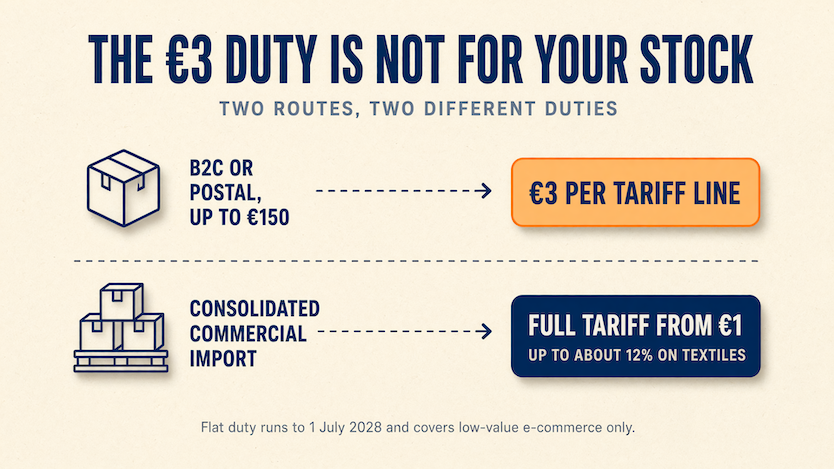
Council Regulation (EU) 2026/382 replaced the €150 relief with a flat duty for low-value e-commerce only. Stock imported as a consolidated commercial consignment through a forwarder is outside it. · alt: Two EU import routes compared: a B2C or postal consignment up to €150 pays €3 per tariff line, while a consolidated commercial import pays the full Common Customs Tariff from the first euro.
Where the flat duty does apply, it is charged per item, and “item” is defined in Article 1(61) UCC-DA as goods in a consignment sharing the same tariff classification, description and origin. It applies “per item, based on tariff classification and not quantity”. The Commission’s worked example: “if you buy 5 T-shirts, a €3 customs duty will be applied (as all T-shirts fall under the same tariff classification)”, while “if you buy 3 T-shirts and a watch, a €6 customs duty will be applied”. Under the amended Article 228(1) UCC-IA those lines may not be grouped where the €3 duty applies.
The UK has not yet followed. A sub-£135 parcel still pays import VAT but no customs duty, which since 1 July 2026 has made the UK materially cheaper than the EU on low-value e-commerce. That is ending: the government announced on 23 June 2026, and confirmed in HMRC’s consultation response of 13 July 2026, that Low Value Imports Relief will go by October 2028 at the latest, brought forward from March 2029 after import volumes trebled between 2021 and 2024, so it could land sooner rather than later.
The practical consequence for anyone dropshipping 1688 goods direct to EU consumers is that mixed-SKU parcels became structurally more expensive overnight, while single-category shipments barely moved. A parcel spanning four product categories carries €12 in flat duty before VAT. Using IOSS also preserves single-entry-point clearance; without it, shipments must clear in the destination member state rather than anywhere in the EU. A separate EU handling fee has been announced for November 2026 at the earliest, but no official amount has been published, so ignore the figures circulating in trade press.
| Date | What changed | Instrument |
|---|---|---|
| 2 May 2025 | Duty-free de minimis ends for China and Hong Kong | Executive Order 14256 |
| 29 August 2025 | Suspended for all countries | Executive Order 14324 |
| February 2026 | Suspension continued | Executive Order 14388 |
| 24 June 2026 | Suspended indefinitely as a matter of regulation | Two CBP interim final rules |
| 1 July 2027 | Repealed by statute | Public Law 119-21 |
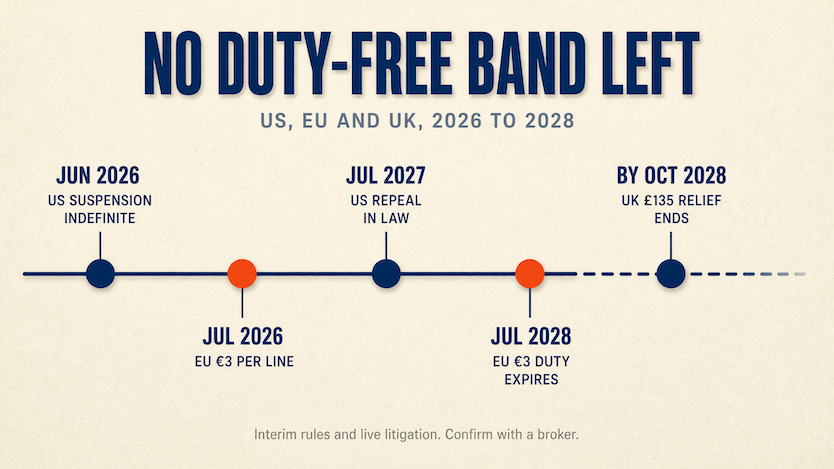
The same dates as a timeline. Nothing here leaves a duty-free route into the US or the EU, and the UK’s remaining relief now has an announced end date. · alt: Duty-free thresholds across three markets from 2026 to 2028: the US suspension indefinite from June 2026 and repealed by law in July 2027, the EU €3 flat duty from July 2026 to July 2028, and the UK’s £135 relief ending by October 2028.
Executive Order 14388 continued the suspension in February 2026 and abolished the postal flat-fee tiers before the June 2026 rules made it indefinite. Practically: release from manifest is gone, Entry Type 86 is suspended, Entry Type 11 informal entry is now the normal route at or below US$2,500 with formal entry and a customs bond above that, and someone must be the importer of record. On duty, the Supreme Court held in February 2026 that IEEPA does not authorise tariffs and those duties were terminated; the 10% surcharge that replaced them expired on 24 July 2026; and a new Section 301 forced-labour tariff took effect the same day across 60 economies at 10% or 12.5%, with China, Hong Kong, Vietnam and Brazil in the 12.5% band. A product pays its MFN rate plus any legacy Section 301 duty plus the new tariff, which is mutually exclusive with Section 232, with anti-dumping duties separate on top. Confirm classification with a licensed customs broker.
| Three problems, one missing thing Domestic-only shipping, a supplier with no export licence, and no way to consolidate four sellers into one box are not three problems. They are one problem: you do not have an address in China. Every solution in this article is a way of renting one. Yakkyofy’s 1688 integration is the version where the address, the check on the goods, the consolidation and the export paperwork are the same service, suppliers ship domestically, and what leaves China is your parcel with the documents already attached. The 2026 duty arithmetic above does not change, and duty is still yours to pay. What changes is the number of parties who can lose your order. Product pricing is visible without an account on the 1688 catalogue. |
|---|
How do you ship a 1688 order to the USA, step by step?
Eight steps. Two of them happen before you place the order (choosing the forwarder and getting their warehouse address) because a domestic supplier paid without a valid Chinese delivery address leaves you holding goods you cannot collect. Budget $300 per man-day for the inspection in step 5.
- Choose a freight forwarder before you order anything. Send every shortlisted forwarder the same five questions so you are comparing like with like: their all-in per-parcel or per-CBM cost; which Incoterm that quote is on and what is excluded; which volumetric divisor they bill on; their free-storage window; and what happens to your goods if a container is delayed.
- Get their Chinese warehouse address, including the contact name and phone number the courier will need. This goes in the 1688 delivery field.
- Screen the supplier for export capability before you pay. Paste this into the 1688 chat: “Can your company file the export declaration itself, or would this order need agency export? Do you hold the product certificates required for my destination market?” If the answer on export is no, confirm your forwarder provides agency export.
- Place the order with the forwarder’s warehouse as the delivery address, and tell the forwarder what to expect: most want an inbound notice so parcels are not received as unidentified freight.
- Book a pre-shipment inspection while the goods are still in China. A third-party check runs $300–$320 per man-day. Once goods have been exported, returning them costs more than most orders are worth.
- Let the forwarder consolidate. Multiple supplier parcels become one consignment with one entry, one set of documents and one duty payment. Per-parcel shipping is what destroys the 1688 price advantage.
- Confirm who is the importer of record and who files the entry, in writing. Ask which HS code and declared value will be used, whether a licensed US broker is filing, and who pays if CBP orders an examination, storage or additional duty.
- Budget for the surcharges, not just the freight. Clearance processing, duty-tax handling, remote-area delivery and non-standard packaging fees routinely add more to a small shipment than the carriage itself.
One warning about the cheapest quotes you will be offered. A per-kilo “DDP” rate that is dramatically below everyone else’s usually reflects a grey clearance channel, and buyers know it: “as far as I know, this DDP per kg service is practically never legal, but it’s the most compelling shipping method for new importers like myself with a tight budget.” Working forwarders in the same thread put the seizure risk anywhere between 0.0001% and “medium”, which tells you the risk is unquantified rather than small. The useful test came from a China–US logistics professional: “‘Per kg’ does not automatically mean illegal, but promises like ‘tax-free,’ ‘no customs risk,’ or refusal to explain the entry structure are major red flags.”
Why does shipping cost more than the product?
Because you are paying per parcel for goods priced per unit. Sellers shipping individually report freight of “$30-100 per unit while the product itself costs $3-5.” Consolidation is not an optimisation on the 1688 route. It is the thing that makes the route work at all.
The 1688 price advantage is real but small in absolute terms: a dollar or two a unit. International freight is a fixed cost per shipment plus a variable cost per kilo, and neither scales down to a single unit. Ship one item and the fixed component (clearance, handling, minimum charges) lands entirely on that item. Ship four hundred and it disperses. This is why a buyer quoted “$20/kilo” by a consolidator and “$22/kilo” by a shipping company is not being cheated so much as being quoted the true cost of moving a small parcel a long way.
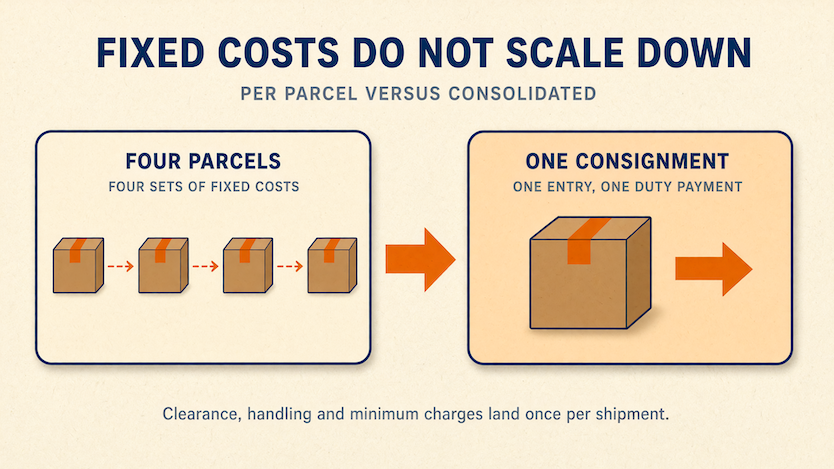
International freight is a fixed cost per shipment plus a variable cost per kilo. Ship one item and the whole fixed component lands on that item. · alt: Four separate 1688 parcels each carrying their own fixed shipping costs, against one consolidated consignment with a single entry and duty payment.
There are three honest ways out, and they are not equally available. Order enough to justify a consolidated shipment. Switch to ocean freight and accept the transit time. Or use a service that consolidates other people’s orders alongside yours, which is the only route that works at test volumes, and it is what a fulfilment platform is actually selling. Yakkyofy, which publishes this guide, runs that model: goods from 1688 are received and checked at its Dongguan warehouse, consolidated, and shipped worldwide under one account, with many products available from a single unit. See the 1688 integration or current pricing.
Payment is the other wall on this route, and it has its own answer. See how to pay on 1688 without Alipay. For the full picture of what an agent does and which parts you can replace yourself, see how to buy from 1688 without an agent and the channel overview in buying from China on 1688.
| Ship per parcel and sellers report freight of $30–100 a unit on a $3–5 product. Consolidation, pre-shipment checks and delivery priced in your currency instead, from one unit up. Duty and clearance for your market still sit on top, as they do on any route. ➜ Price your shipment free |
|---|
Yakkyofy handles 1688 sourcing, consolidation, quality checks and duty forecasting from a single unit up, so you don’t need to solve these problems yourself.
Frequently asked questions
Does 1688 ship internationally?
No. 1688 suppliers deliver to Chinese addresses only, and the platform runs no international consolidation or shipping service open to a foreign buyer. Its cross-border surfaces at kj.1688.com and global.1688.com do carry export logistics (including overseas fulfilment), but those are tools sold to Chinese merchants shipping their own overseas orders, you cannot point one at a 1688 listing as an overseas buyer. To get goods to the USA you give the supplier a freight forwarder’s Chinese warehouse address, and the forwarder consolidates, declares and exports the shipment.
How do I get a 1688 order shipped to the USA?
Choose a freight forwarder first, get their Chinese warehouse address and contact details, and enter that as the delivery address on your 1688 order. The supplier ships domestically to the warehouse; the forwarder receives and consolidates your parcels, files the export declaration, and arranges international carriage. Book any quality inspection while the goods are still in China, because returning them afterwards usually costs more than the order.
How much does shipping from 1688 to the USA cost?
DHL’s published 2026 China tariff to the USA (Zone 6) is ¥505 at 0.5 kg, ¥1,959 at 5 kg and ¥6,549 at 20 kg before fuel surcharge, but negotiated 3PL rates are far lower, with the same 0.5 kg parcel benchmarked at about US$31. Above roughly 500 kg, ocean freight becomes competitive; Drewry assessed Shanghai–Los Angeles at US$5,894 per 40ft container in August 2026. Get a written quote for your own weight and lane.
How long does 1688 shipping to the USA take?
Express carriage runs 3–5 business days once goods leave China, but door-to-door is longer because of consolidation waits and clearance. Plan for 3–7 days waiting at the Chinese warehouse, 2–5 days for US customs clearance and up to two weeks if documentation is queried. On ocean freight, only about 60% of vessels arrived on schedule through the first half of 2026, and late arrivals averaged 5.2–5.5 days behind.
Do 1688 suppliers have an export licence?
Many do not. Under GACC Order No. 253 only a registered import/export consignee or a licensed customs broker may file a Chinese export declaration, and a purely domestic 1688 wholesaler generally holds neither. Ask the supplier directly whether they can handle export, and whether they hold the product certificates your market requires. Where they cannot, the compliant route is agency export through a licensed foreign-trade agent, which your forwarder can usually arrange.
Do I still pay duty on a small parcel from China to the USA?
Yes. The $800 de minimis exemption ended for China and Hong Kong in May 2025, was suspended for all countries in August 2025, and was made indefinite by CBP regulation in June 2026, with statutory repeal from 1 July 2027. There is no longer a value band that clears duty-free. CBP measured average duties, taxes and fees of 8.62% across 392,312 low-value informal entries, excluding tariffs that have since changed. Confirm your own classification with a customs broker.


