
What a sourcing agent actually does on 1688, what the published fee schedules mean, and where the economics break even. Sourcing agents have become cheaper and less necessary, but not yet invisible: the $100 flat minimum on small orders still costs more than many products.
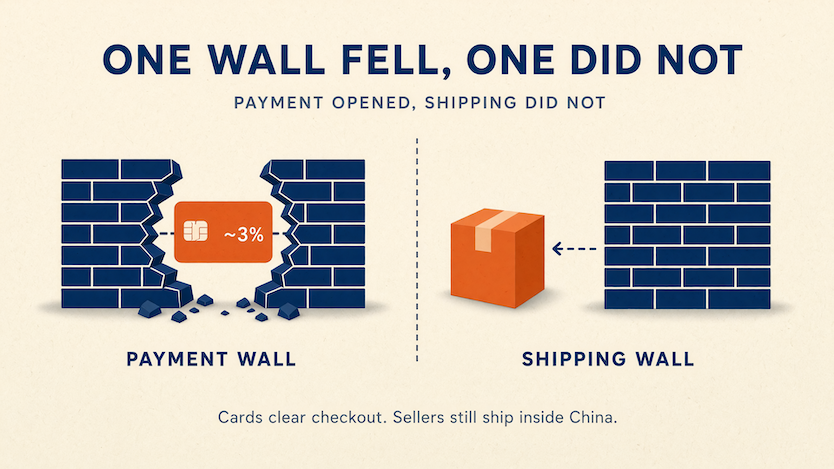
Working out how to buy from 1688 without an agent used to have a short answer: you couldn’t, not at a profit. The payment and shipping walls were real barriers and required specialist infrastructure. Both have come down. International card checkout works, and the shipping wall crumbled the moment a buyer discovered that the thing you do is send goods to a forwarder’s Chinese warehouse instead of trying to ship directly from the supplier.
The language barrier was never the wall; machine translation solved it three years ago. The hard part is the piece that cannot be automated: finding a factory whose quality and reliability suit your threshold, and arranging their paperwork to move goods legally out of China. That is what an agent charges for. That is also the piece you can bypass with time and a network, and below roughly $500 an order, the economics of paying an agent minimum often don’t work. This guide walks through how to buy direct, what a sourcing agent actually does, when one is worth paying for, and how the pricing works.
Can you buy from 1688 without a sourcing agent?
Yes, though not the way most guides describe. Foreign Visa and Mastercard checkout works. The delivery address can be a Chinese forwarder’s warehouse, not yours. The hard part is pre-shipment quality control and export paperwork, not the transaction itself.
Three things have changed since 2020. First: 1688 opened international card checkout to all accounts in March 2024. Before that, the payment wall was real — you needed Alipay or a Chinese bank account. Now you don’t. Second: the shipping wall was never a shipping problem. It was a warehouse problem. Suppliers ship domestically to Chinese addresses only. The answer is that you find a Chinese warehouse (a consolidation forwarder, or a 1688 integrated platform) and give the supplier that address instead of yours. Third: the paperwork wall is still there. Exporting goods legally out of China requires a customs-registered declarant, which most small 1688 suppliers don’t hold.
So the route direct is: register and pay with an international card, ship to a forwarder’s warehouse, contract a licensed agent or customs broker to file the export paperwork (which is cheaper than a full sourcing agent), and consolidate your shipment with anyone else’s at the same warehouse to keep freight costs down. You don’t need the sourcing agent if you can do quality control yourself or you trust the supplier’s track record. You still need the export paperwork piece.
What does a 1688 sourcing agent actually do?
An agent negotiates the price, verifies the supplier, arranges production samples, performs pre-shipment inspection, consolidates with other orders, arranges international freight, acts as importer of record, and handles the export paperwork. It is a collection of services you can unbundle and buy separately.
Sourcing agents don’t act as manufacturers. They take a buyer’s order, find a factory (or broker other buyers’ orders to existing suppliers), negotiate volume and customisation, take payment, quality-check the finished goods, and arrange export and delivery. The full list of tasks looks like this:
| Task | What this means | Do you need an agent for this? |
|---|---|---|
| Source and screen the supplier | Search 1688 (or Alibaba.com, Global Sources, Canton Fair databases) and vet the factory: credentials, production capacity, track record, and willingness to work with foreign buyers | Only if you don’t want to spend time on research or don’t have a network. Machine translation, LinkedIn, and five years of established review histories on 1688 reduce this risk sharply. |
| Negotiate price and MOQ | Haggle over unit cost, minimum order quantity, and customisation options. Agents often do this better because they consolidate orders or work with the same factory repeatedly | Necessary if the supplier demands a high MOQ and you can’t meet it, or if you need significant customisation. Unnecessary for standard products where the listing price and MOQ are acceptable as written. |
| Order and payment | Confirm terms and pass payment to the factory | No. You can do this yourself now on 1688 with an international card. |
| Production and samples | The factory manufactures the goods and (for small orders or custom work) first sends a sample for approval | No, but you need to budget time: sample turnaround is often 5–10 working days, then you review and approve before full production starts. |
| Quality inspection | Before dispatch, someone (ideally in person at the factory, or via a third-party inspector) verifies that goods meet specifications. This is the highest-value service an agent provides | Yes, unless you trust the supplier completely or the defect cost is low. A pre-shipment inspection costs $300–$600 per man-day. Once goods have left China, the cost of return or replacement is usually higher. |
| Consolidation | If you’ve sourced from multiple suppliers, an agent’s warehouse combines them into one shipment with one customs entry | Yes, if you source from multiple suppliers. Consolidation reduces your per-unit freight cost and halves your customs paperwork. |
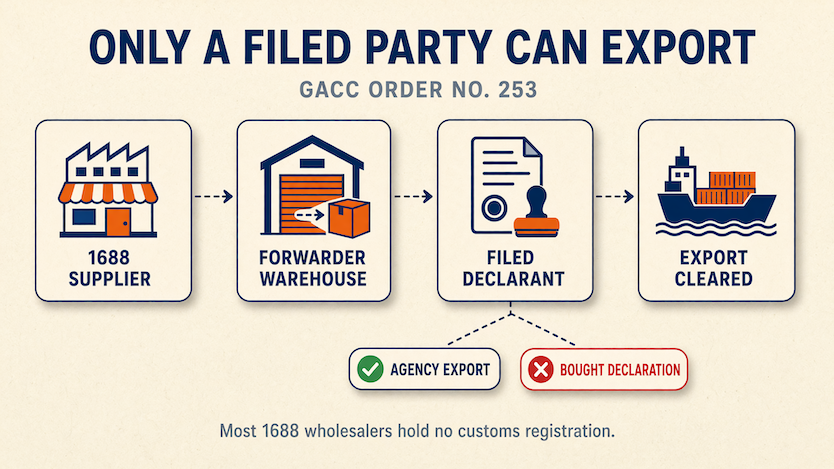
| Export paperwork | A customs-registered declarant files the export declaration and handles foreign-exchange settlements | Yes. Under GACC Order No. 253, only a company registered with Chinese Customs can file. Most small factories are not. The agent’s solution is either to file themselves (if they hold a foreign-trade licence) or to arrange a licensed customs broker to do it on their behalf. |
| International freight | Arranging carriage to your country (air, ocean, or express courier) and handling customs clearance on the destination side | No, but you benefit from an agent’s freight volume discounts. The agent has negotiated rates with carriers; you book spot rates. The gap averages 20-40%. |
| Importer of record | Post-de-minimis, an importer of record (IOR) must exist on the customs entry, hold a bond for formal entry, and take responsibility for duty payment and any fines | Yes, unless you’re willing to be the IOR yourself in your own country. Many agents are incorporated overseas (typically in Hong Kong or Singapore) and offer to hold the IOR role; others require you to appoint a licensed customs broker in your country. |
The sourcing piece — sourcing and screening the supplier — is the part most people think the agent does. Most agents do offer it, but it is not their primary value. Verification has become commodified: you can do it yourself with a LinkedIn lookup and a review of the 1688 rating. The parts that are hard to replace are pre-shipment inspection (which requires access to China or a trusted third-party inspector), consolidation (which requires warehouse infrastructure), and export paperwork (which requires customs registration). If you can arrange those three things, you don’t need a full-service sourcing agent.
How much do 1688 sourcing agents charge?
There is no standard rate. Published schedules range from 7% commission to $100–$300 flat minimums on small orders. On orders under $500, the minimum often costs more than the agent’s percentage rate would, so you pay the minimum. Between $500–$2,000 orders often tip toward commission-based.
Sourcing agents price themselves four ways: percentage commission on the order value, flat fee per order, combination (percentage + minimum), or project-based (for large custom orders). Published rates scatter widely because the service is highly competitive and margins depend heavily on order size and supplier relationship.
| Company | Pricing model | Typical cost on a $200 order | Typical cost on a $2,000 order |
|---|---|---|---|
| Leeline Sourcing | 7% commission; $100 minimum on orders under $500 | $100 (flat minimum) | $140 (7%) |
| Alibaba.com 1688 channel | Integrated: no separate agent fee (markup on negotiated price) | Negotiated on-platform | Negotiated on-platform |
| Yakkyofy (Dongguan warehouse model) | Integrated: receives goods at warehouse, no per-order fee for inspection/consolidation | Per-unit landed cost model (published list, no hidden fee) | Per-unit landed cost model |
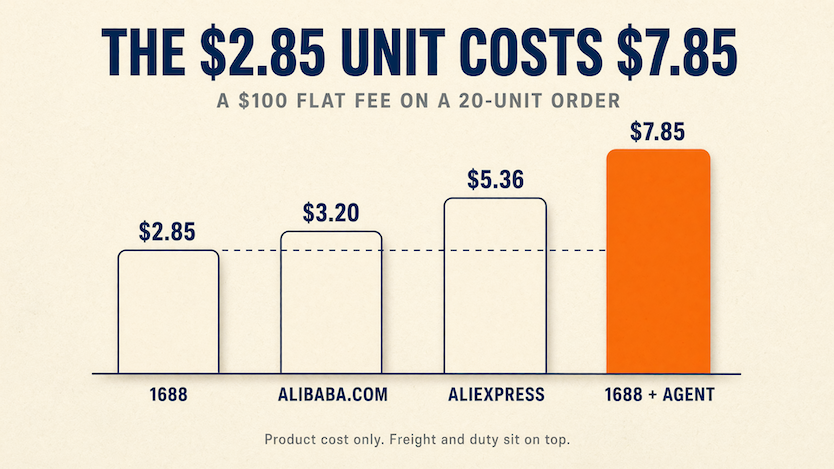
On a $200 order at 7% you’d owe $14 to the agent, but they charge a $100 minimum, so you pay $100. On a $2,000 order, you hit the 7% rate and pay $140. Many agents won’t quote below a minimum, which is why the cheapest agent is not always the one with the published 5% rate — if that agent’s minimum is $300 and Leeline’s minimum is $100, Leeline is cheaper on a small order.
There is no standard rate, and published schedules vary enormously. Leeline’s published ladder opens at $100 for orders under $500. Xiaoyuzhou charges 5% with a $50 minimum. Sourcify quotes project-based on complexity. Searching “1688 sourcing agent” on Google returns a wide spread of pages, most of them agents’ own claims with no third-party verification. The only way to know what you’ll pay is to request a quote.
The economic reality: below roughly $500 an order, commission economics work against you. A $100 flat minimum on a $200 order is a 50% markup on product cost. At $2,000 an order, it’s 5–7% markup, which stings less. A buyer’s decision to go direct therefore makes more financial sense the smaller the order.
The cost of what an agent does and how to replace it
Pre-shipment inspection costs $300–$600 per man-day. Export paperwork through a broker costs $200–$500. Consolidation saves money, not costs it (you save on freight). The agent’s main value on small orders is the flat minimum going away once you order $500+.
If you choose to go direct, each service the agent was providing is available separately — and often cheaper than their bundled minimum, if you know where to look.
Pre-shipment inspection
Hire a third-party inspection company (SGS, Intertek, CIQ, ASA, or local Chinese inspectors available through Alibaba services). Cost: $300–$600 per man-day, often a half-day for straightforward checking. Note: once goods have already left the factory and are in transit or in a port, returning them costs orders of magnitude more than the inspection would have. Budget for the inspection before the goods ship.
Export paperwork
A 1688 supplier with no foreign-trade export licence needs a licensed customs broker or a foreign-trade agent to file the export declaration on their behalf. This is not optional — the supplier cannot legally export without it. Costs vary by broker, roughly $200–$500 for the declaration, sometimes bundled with freight forwarding. If your forwarder has a customs department in-house, they can do it. If not, ask them to introduce you to a broker or arrange it themselves. The cost is typically less than a full-service agent’s minimum.
Consolidation
Consolidation doesn’t cost anything — it saves money. A forwarder’s warehouse consolidates multiple shipments for free (or for a small handling fee, $5–$20). Consolidation reduces your freight cost because the carriage rate is per-kilo, and spreading a freight charge across four suppliers instead of shipping one supplier per shipment moves the per-unit freight cost down. This is why per-parcel shipping costs so much and consolidation is so valuable.
Importer of record
You can be your own IOR if you’re established in your destination country. If you prefer not to, a licensed customs broker or forwarder will hold the role for you, typically as part of the freight quote (no additional fee). The constraint post-de-minimis is that someone must hold the role; it cannot be left blank. That someone can be you, a broker, or a forwarder, and only one of them costs extra (and then only if you hire a broker separately from your forwarder).
When sourcing agents make economic sense
Below roughly $500 an order, commission economics work against you: a $100 flat agent minimum costs more than the agent’s percentage rate would. Below $500 and you still have time (you’re not urgent), direct 1688 buying works. Above $500, agents become viable. With custom specs or high volumes, agents save more time than they cost.
A rough rule: stay with an agent for irregular or custom buying where negotiation and re-negotiation are part of the work. Switch to direct 1688 for repeat or standard-spec orders where you’ve already vetted the supplier and the MOQ and price are acceptable.
A small number of platforms integrate with 1688 directly rather than acting as a traditional sourcing agent. Yakkyofy’s model is different: you post a product link or description, it is sourced from 1688, goods move to a Dongguan warehouse for consolidation and pre-shipment check, and you receive a landed-cost quote including duty before the order ships. This collapses the agent’s services into a per-unit model priced transparently upfront. No hidden minimums, no negotiation per order, no separate inspection fee.
A buyer sourcing by direct 1688 has no agent to negotiate, consolidate or chase the factory. You need a network and time. Yakkyofy’s 1688 integration wraps those services into one account, including consolidation, quality checks and UK/US duty forecasting from a single unit up.
What happens when things go wrong
Without an agent, nothing escalates for you — there is nobody to chase the factory or hold the goods until a dispute resolves. 1688 offers no buyer protection, though Alipay transaction disputes sometimes succeed. Return of defective goods is not a 1688 service. Plan your quality and your disputes.
1688 is a wholesale marketplace. It is not a consumer platform. There is no Trade Assurance programme (1688’s equivalent to Alibaba.com’s buyer protection). If the supplier ships you defective goods, there is no mechanism to escalate, and the supplier has no incentive to reverse a decision — they’ve already been paid.
That is the hard-wired reality of direct buying from 1688, with or without an agent, but agents provide value by making the escalation feel less hopeless: they have an ongoing relationship with the supplier and can sometimes negotiate a re-shipment, discount, or partial refund. But that is not a guarantee, and it costs the agent time (which factors into their margin).
The only built-in protection is the Alipay transaction dispute process, which succeeds sometimes (not always). The protection is entirely transactional, not about goods — Alipay can only reverse payment, not force a refund if the goods have shipped.
Quality with no gate
1688 inspects nothing before dispatch. Once defective goods ship out of the warehouse, your only recourse is to negotiate with the supplier directly, and leverage is limited. This is why pre-shipment inspection (or a relationship of trust with the supplier) is not an optional service — it is the cost of doing business on 1688.
No Trade Assurance
Trade Assurance is an Alibaba.com programme covering orders up to a deposit amount (up to 50% of the order value, capped at $30k) for 90 days after shipment. 1688 has no equivalent, and Alipay transaction disputes are not the same — an Alipay dispute can only reverse payment if filed before goods ship. Once goods leave the warehouse, payment reversal becomes far harder.
Per-parcel freight
Shipping each order individually by air is what produces the “$30–$100 per unit freight cost” problem that makes small direct orders unviable. If you source from five suppliers, ship five parcels, your freight bill explodes. An agent (or a consolidation platform) wraps five orders into one consolidated shipment with one customs entry and one carriage bill. Consolidation is the only mechanism that makes small orders work.
No importer of record
Post-de-minimis, somebody must be the IOR on your customs entry. Appointing someone is not optional. If you’re buying directly without an agent, you need to answer who that is before the goods ship. It can be you (if you’re established in your country), a customs broker, or a forwarder — but it cannot be left blank.
Should you replace the agent, or replace the whole layer?
There is a meta-problem too: finding a trustworthy agent is hard, which is part of why buying from China is hard. The typical buyer’s journey goes: search Google for “1688 sourcing agent,” find 50 pages of agents and consultants, cold-email 5–10, get replies from 3, request quotes, and realize the quotes are incompatible (one includes freight, one doesn’t; one includes inspection, one doesn’t). The decision point is not whether one agent is cheaper than another, but whether you want to spend time vetting agents at all.
The opportunity in that friction is platform consolidation. An agent is a broker who bundles services that could be bought separately or vertically integrated. A platform that skips the negotiation and integration of external services (inspection, freight, customs) and builds them in-house can offer a simpler contract: “send me a product link; I’ll quote you a landed price.”
That is not a sourcing agent. It is a replacement for the whole category.
Frequently asked questions
Can you buy from 1688 without an agent in 2026?
Yes, with one hard limit. You can register, search, negotiate and now pay, international Visa and Mastercard checkout opened in March 2024. The shipping logistics are solvable: send goods to a forwarder’s warehouse instead of your address. The hard part you cannot easily replace is pre-shipment quality control and the export paperwork (which requires a customs-registered declarant). Those two pieces are why sourcing agents exist.
Do you need Alipay to buy from 1688?
Effectively, yes. You do not need a Chinese bank account, but both official payment routes require you to go through the Alipay gateway, which involves a Chinese ID, residence verification, and a linked bank account (Chinese or foreign, but the linking process is typically via Chinese banking infrastructure). The workaround used by foreign buyers is to use a third-party payment agent or processor (e.g. pay via Wise transfer to a 1688 wholesale agent account, which is not officially supported but happens in practice). The official path is Alipay.
How much do 1688 sourcing agents charge?
There is no standard rate, and published schedules vary enormously. Leeline’s published ladder opens at $100 for orders under $500, then 7% commission. Xiaoyuzhou publishes 5% with a $50 minimum. Sourcify quotes project-based. On orders under $500, a typical flat minimum ($100–$150) often costs more than the agent’s percentage rate would charge, so you pay the minimum. The only way to know is to request a quote from agents in your product category.
What happens when a 1688 order goes wrong and there is no agent to escalate to?
Nothing escalates for you. There is no agent to chase the factory, and there is no Trade Assurance or buyer protection on 1688. The only built-in mechanism is an Alipay transaction dispute, which can sometimes reverse payment if filed before the goods ship, but not after. Once goods leave the factory, your leverage is the supplier’s reputation (and their willingness to make things right informally) plus the cost of returning goods, which is usually higher than the order value. This is why pre-shipment inspection is considered mandatory on 1688, not optional.
Can I buy a single unit from 1688 for testing?
It depends on the supplier. 1688 MOQs are set per listing and are often far lower than export-oriented sites like Alibaba.com (which favor bulk). Many 1688 suppliers will sell a single unit or a handful for testing or sample purposes, especially for standard products. Search for the product in Chinese if possible (use Google Translate or Baidu) — listings that openly state “1 piece OK” or “MOQ 1” exist on 1688. For custom or capital-intensive products (machinery, tooling), MOQs will be higher and the supplier may demand a deposit before a sample is produced.
What import duty will I pay on 1688 goods in 2026?
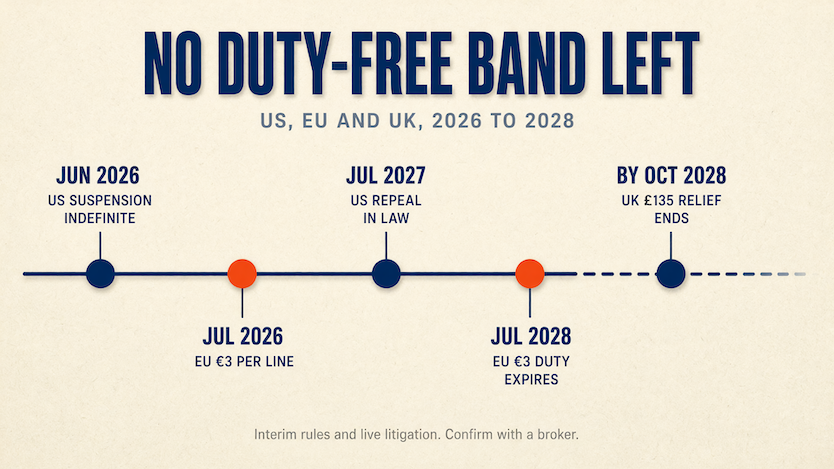
It depends on destination and product, and both major markets changed in 2026. The US $800 de minimis exemption ended permanently in June 2026 and is repealed by statute in July 2027 — all commercial imports now pay duty. The EU abolished its €150 relief and replaced it with a €3 flat duty on low-value e-commerce only (July 2026–July 2028), but commercial consolidated imports pay the full Common Customs Tariff. The UK’s £135 relief expires by October 2028. No duty-free band survives into 2027+. Duty itself is product-specific (by HS code) and often includes layered tariffs (MFN rate + Section 301 surcharges + forced-labour Section 301 tariffs for China at 12.5% as of July 2026). Confirm your own classification and destination with a licensed customs broker.


