
Choosing among the best dropshipping suppliers is one of the most consequential decisions you’ll make for your e-commerce operation. Get it wrong and you’re looking at stockouts during peak campaigns, customer complaints you can’t resolve, and margins that erode faster than you can scale. This guide breaks down the top options available in 2025, what they actually offer, and what they don’t tell you upfront.
What makes a dropshipping supplier worth your business
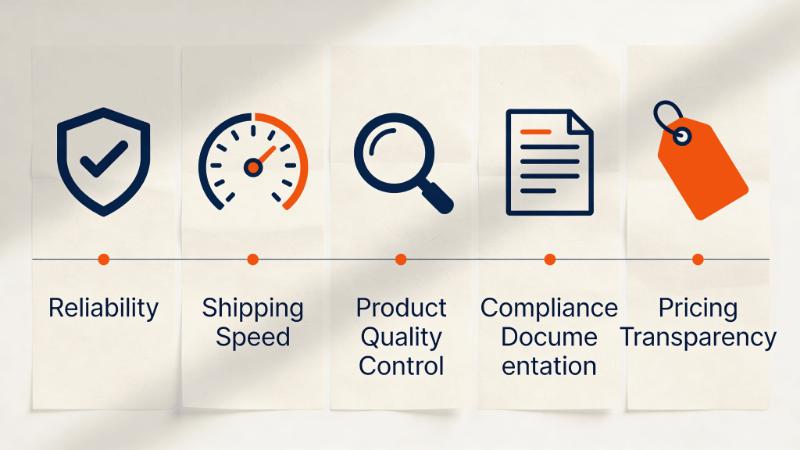
Before listing names, here’s the evaluation framework that matters for established operators:
- Operational continuity: does the supplier go dark during Chinese holidays, peak seasons, or supplier disruptions?
- Quality control: is there a systematic pre-shipment inspection process, or are you shipping blind?
- Pricing transparency: are you getting factory-level pricing or paying for intermediary markups?
- Compliance: does the platform issue EU/US-compliant invoicing, or will your accountant reject every document?
- Scalability: can the supplier handle volume spikes without degrading service?
If a supplier can’t give you a clear answer on all five, that’s your answer.
The top dropshipping suppliers reviewed
1. Yakkyofy
Yakkyofy is the platform operated by Yakkyo S.p.A., an Italian company listed on Euronext Growth Milan, making it the only publicly listed dropshipping fulfillment company in Europe. That distinction matters practically: financial statements are public, operational accountability is real, and the company doesn’t disappear overnight.
Key differentiators, based on documented platform capabilities:
- AI-driven product intelligence: over 35 million products analyzed daily by a proprietary AI engine, with predictive sales algorithms identifying trending items on a rolling basis
- Quality control with documentation: systematic pre-shipment inspections with PDF reports, not a checkbox on a supplier form
- EU-standard invoicing: Italian-based billing and compliance, relevant for EU-based sellers managing VAT obligations
- Private label and custom packaging: available on paid plans, relevant for brand-building operations
- Dedicated account management: available on Premium+ tier for high-volume operators
- Year-round operations: the platform maintains operational capacity during periods when many China-based suppliers reduce availability, including the Chinese New Year period
- Professional product photography: including 3D and 360° rendering via AlphaShot XL technology
Shipping options typically range from standard (9-15 business days) to express (3-7 business days), depending on destination and service tier. Actual delivery times may vary based on customs processing, destination country, and carrier availability.
Best for: E-commerce operators generating meaningful revenue who need supply chain reliability, EU compliance, and brand-building capabilities not beginners looking for the cheapest entry point.
2. CJ Dropshipping
CJ Dropshipping is a China-based fulfillment platform offering product sourcing, warehousing in multiple countries and order automation. It supports a wide product range and offers photo/video production services.
Strengths: Broad product catalog, international warehouse network, sourcing on request.
Weaknesses documented by users: Platform interface has a steeper learning curve than alternatives; product quality consistency varies by supplier; customer support response times can be slow during high-demand periods (publicly available user reviews).
Best for: Operators comfortable managing supplier relationships independently who need geographic warehouse flexibility.
3. AliExpress
AliExpress is a retail marketplace, not a dedicated dropshipping platform. It gives access to an enormous product catalog at low price points, but individual sellers on the platform vary significantly in reliability, shipping times, and quality standards.
Strengths: Massive product selection, low barrier to entry, no MOQ on most listings.
Weaknesses: No systematic quality control, shipping times from China typically range from 15 to 45+ days depending on the shipping method selected, and customer support for disputes is limited.
Best for: Beginners testing product-market fit with minimal upfront investment. Not suitable for scaling a brand-focused operation.
4. Alibaba
Alibaba connects buyers directly with manufacturers and is primarily designed for bulk purchasing, not per-order dropshipping. Some suppliers on the platform offer dropshipping arrangements, but this typically requires negotiation and a minimum relationship-building period.
Best for: Operators moving into wholesale or private label manufacturing with higher order volumes.
5. Spocket
Spocket curates a network of suppliers primarily based in the US and Europe, which translates to faster domestic shipping times — typically 2–7 business days for US/EU customers, the platform integrates with Shopify, WooCommerce, Wix, and BigCommerce.
Strengths: Faster shipping for Western markets, branded invoicing on higher tiers, product samples available.
Weaknesses: Product costs are higher than China-sourced alternatives, catalog depth is more limited, and advanced features require higher-tier subscriptions.
Best for: Merchants competing on delivery speed in the US/EU market rather than on price margin.
6. SaleHoo
SaleHoo is a verified supplier directory not a fulfillment platform. It provides access to a database of vetted wholesalers and dropship suppliers, along with a market research tool and educational resources.
Best for: Operators who want to identify and vet suppliers independently before building direct relationships.
7. Printful
Printful is a print-on-demand fulfillment platform. It handles production and shipping of custom-designed products (apparel, accessories, home goods) on a per-order basis with no inventory required.
Best for: Creators and brand operators focused exclusively on custom-printed merchandise. Not relevant for general product dropshipping.
8. DSers
DSers is the official AliExpress dropshipping tool, replacing Oberlo (which was discontinued in 2022). It allows bulk order management, supplier comparison, and automated order processing directly connected to AliExpress supplier network.
Best for: Shopify operators running AliExpress-based stores who need order automation at scale.
9. Doba
Doba consolidates multiple suppliers into a single interface, simplifying sourcing and product listing. It integrates with major e-commerce platforms and offers a subscription-based model.
Strengths: Centralized supplier access, user-friendly interface, broad platform integrations.
Weaknesses: Subscription costs are relatively high; shipping times vary significantly by supplier; customer service quality is inconsistent (SOURCE: user reviews).
Best for: Operators who want a broad product catalog without managing multiple supplier relationships directly.
10. BigBuy
BigBuy is a European wholesale and dropshipping platform with a big products catalog including recognized consumer brands. It operates a warehouse in Europe with delivery times of 24–48 hours within the EU.
Strengths: European warehouse, brand-name products, multichannel integrations.
Weaknesses: High subscription and registration costs, limited options for non-EU shipping, complex onboarding for beginners.
Best for: EU-based operators focused on selling branded consumer goods domestically.
How to choose the right supplier for your operation
The right supplier depends on where your business actually is, not where you want it to be. A few practical decision points:
- If you’re generating consistent revenue and need operational stability, prioritize accountability, compliance, and quality control over catalog size
- If speed-to-market in the US or Europe is your main competitive lever, localized supplier networks reduce the friction
- If you’re building a brand rather than arbitraging products, private label capabilities and custom packaging are non-negotiable
- If you’re early-stage and testing, low-barrier platforms with broad catalogs reduce your initial risk exposure
One factor often underweighted: what happens when something goes wrong. A supplier’s dispute resolution process, documentation quality, and communication reliability under pressure reveal more about the relationship than their sales pitch.
Faq
-
What’s the difference between a dropshipping supplier and a dropshipping platform?
A supplier manufactures or warehouses products. A platform is the software layer that connects you to suppliers and automates order processing. Some companies, like Yakkyofy, cover both roles by providing sourced products and managing fulfillment end to end.
-
How do I verify that a dropshipping supplier is reliable before committing?
Review pre-shipment quality inspection documents, confirm shipping carrier partnerships, verify compliant invoicing for your target market, and check publicly available company information. Placing trial orders before scaling is standard practice.
-
Do I need a different supplier for EU and US markets?
Not necessarily, but shipping costs and delivery times vary by origin. Platforms with multi-region warehouses can reduce both. For EU sales, confirm VAT and IOSS-compliant documentation.
-
What happened to Oberlo?
Oberlo was discontinued by Shopify in June 2022. DSers is now the recommended AliExpress dropshipping tool and provides similar functionality.
-
Is Yakkyofy suitable for beginners?
Yakkyofy is accessible on a free tier, but delivers the most value to sellers with existing revenue who need scalable fulfillment, EU-compliant billing, and supply chain control. Beginners can start small and benefit more as operations grow.
Start optimizing your ecommerce
operations with Yakkyofy.
Create your account and explore the platform to see how our fulfillment
solutions can support your business growth.


