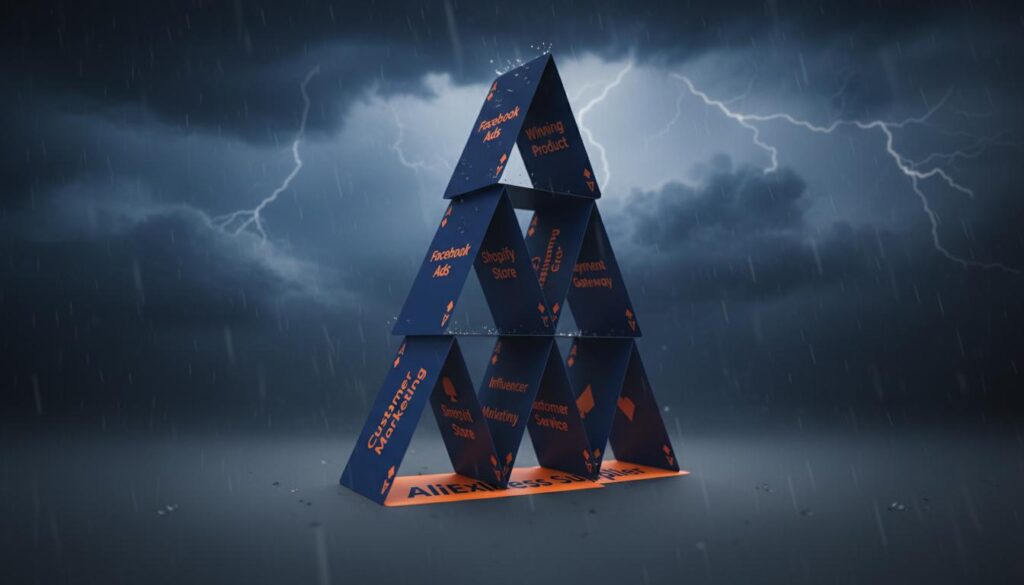

The Illusion of Control: Why Your Successful Store Is Built on Sand
You’ve done everything right. You found a winning product, your ad creatives are converting, and your Shopify dashboard is a sea of green. You feel in control. But this feeling is a dangerous illusion. The dropshipping model that brought you here is built on a foundation of dependencies you don’t own, creating a level of fragility that can wipe out your business overnight. Your success is contingent on third-party platforms that can change their rules without warning, and on anonymous suppliers who can vanish when you need them most. In 2026, the game is no longer just about growth; it’s about survival, and survival requires a robust ecommerce fulfillment strategy.
Consider the recent tremors that have shaken the industry. Merchants wake up to find Shopify has auto-published their entire catalog into the Shop App, breaking regional restrictions and subscription workflows. Others see their conversion data hopelessly skewed by 50-100 fake bot checkouts per day, sabotaging retargeting budgets. These aren’t edge cases; they are the new normal. Relying on a platform is necessary, but believing it has your best interests at heart is naive. The real question is: when the platform shifts or the supplier disappears, what’s holding your business up?
The Four Horsemen of the Dropshipping Apocalypse
For the scaling entrepreneur, the threats are no longer hypothetical. They are daily operational realities that undermine profitability and brand reputation. If you’re managing 20+ orders a day, you’re already fighting these battles.
1. The Unreliable Supplier: A Single Point of Failure
The biggest vulnerability in the classic dropshipping model is the anonymous supplier from a generic marketplace. This isn’t a partnership; it’s a transactional relationship with zero loyalty. When you scale, this weakness becomes fatal:
- Inconsistent Quality: The product that earned you five-star reviews in the first batch is suddenly made with cheaper materials in the second. Your supplier switched factories to save a few cents, and your brand reputation pays the price.
- Processing Delays: Catalog-driven agents are notorious for 3-5 day processing times before an item even ships. During peak seasons like Q4 or shutdowns like Chinese New Year, this can stretch to weeks, leading to a tidal wave of customer complaints and chargebacks.
- The Vanishing Act: Your product goes viral, you send your supplier 500 orders, and they simply disappear. They ran out of stock or found a bigger buyer. Now, you’re left to refund angry customers and your ad momentum is dead.
2. The Fickle Platform: When ‘Features’ Become Bugs
Your e-commerce platform is your landlord, not your partner. They can and will make changes that directly harm your business without consultation. Shopify’s push to integrate all products into its Shop App is a prime example, overriding merchant settings and causing chaos for stores with specific sales models. Furthermore, feature rollouts often remain US-centric, leaving European sellers at a disadvantage. Building your entire operational workflow inside a walled garden you don’t control is a massive, unmitigated risk.
3. The Arbitrage Collapse: Death by Visual Search
The strategy of finding a $5 product on a marketplace and selling it for $30 is dying. Why? Because consumers are no longer passive. With tools like Google Lens, a potential customer can screenshot your ad, perform a visual search, and find the exact same item on another site for a fraction of the price in seconds. Competing purely on price arbitrage is a race to the bottom you will lose. Differentiation can no longer come from just marketing; it must be built into the product and the customer experience itself.
4. The Compliance Nightmare: Taxes and Tariffs
As you scale, you cross invisible lines that introduce staggering complexity. U.S. sales tax nexus rules become a tangled web that can feel impossible for a small team to manage. Worse, geopolitical shifts can weaponize your supply chain. The heavy tariffs imposed on Chinese goods in the U.S. market (adding $10-$25 per shipment) can instantly erase your margins, forcing a pivot to other markets like the UK, Canada, or the EU—markets your current fulfillment partner may not be equipped to handle efficiently.
Building Your Fortress: A Modern Approach to Ecommerce Fulfillment
If the old model is broken, what replaces it? A resilient business built on operational excellence and strategic partnerships. It’s about shifting your mindset from a reseller to a brand owner, and your ecommerce fulfillment from a liability to a competitive moat.
From Anonymous Supplier to Sourcing Partner
The first step is to move beyond marketplaces and establish factory-level relationships. This is the core of Yakkyofy’s model. We are not a marketplace; we are a supply chain management company. Our expertise is in the Chinese market, allowing us to source products directly from vetted factories.
- Real-Time, B2B Quotes: Instead of relying on inflated marketplace prices, our system gets you direct B2B quotes, often from just an image of the product you want to source. This protects your margins from the start.
- Quality Control as a Standard: We don’t just ship boxes; we inspect them. Our team can perform on-site quality control checks (AQL) to ensure the first order has the same quality as the last. This consistency is the foundation of a real brand.
- Operational Continuity: We are a publicly listed company that operates year-round, even during Chinese New Year. While your competitors’ operations grind to a halt, your store keeps selling.
Customization as a Defensive Wall
The most effective way to combat price comparison and build a memorable brand is through customization. This is where you create real, defensible value. With Yakkyofy’s premium plans, you can move beyond generic dropshipping:
- Private Labeling: We work with factories to put your logo on products, creating a unique SKU that can’t be found elsewhere.
- Custom Packaging: Stop shipping in anonymous brown boxes. A branded box with your logo, a thank you card, or custom tissue paper transforms a simple transaction into a brand experience. Learn more about our custom packaging solutions.
Infrastructure That Scales With You
A resilient business needs an infrastructure that can handle success. That means having a partner who can provide more than just shipping. It’s about having an operational backbone:
- Dedicated Support: When something goes wrong, you don’t have time for chatbots or ticket systems. Our clients have a dedicated account manager who speaks their language, ensuring clear communication and fast problem resolution.
- Warehousing and Inventory Management: Use our free mini-stock in China to guarantee 24-hour fulfillment for your bestsellers. Our system provides automated low-stock alerts so you’re never caught off guard by a sudden sales spike.
The Resilient Entrepreneur of 2026
The landscape of ecommerce fulfillment has evolved. The low-barrier-to-entry model of classic dropshipping has been replaced by a more complex, more competitive environment. Thriving in this new era requires a shift in focus from short-term tactics to long-term strategy. It’s less about finding a viral product and more about building a resilient, defensible, and scalable operation.
Your fulfillment process is no longer a back-office task; it is the core of your brand’s promise to its customers. By partnering with a supply chain expert like Yakkyofy, you are not just outsourcing logistics; you are building a foundation of reliability, quality, and control that will allow you to weather the storms and scale with confidence.


