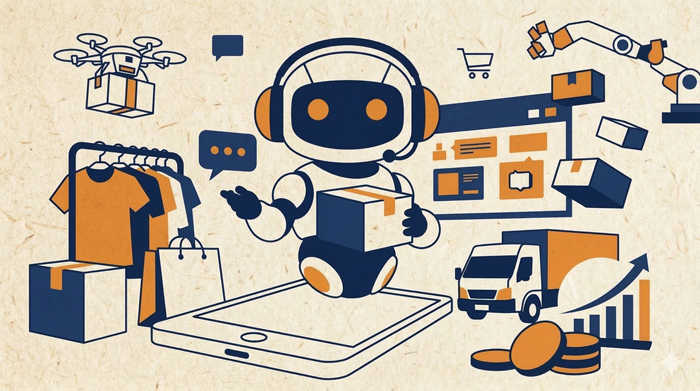

What is an AI chatbot for dropshipping?
This is a conversational AI tool that automates customer support, product discovery, order tracking, and sales conversations for ecommerce stores.
Why it matters
Dropshipping stores often handle hundreds of repetitive questions daily. AI chatbots can automate up to 60–90% of support requests, reduce support costs, and increase conversions by guiding shoppers in real time.
Key benchmarks
- Average ecommerce chatbot automation rate: 60–80% of tickets
- Chat-assisted conversions can increase sales 10–25%
- Support cost reductions: 30–50%
- Typical chatbot ROI payback: 1–3 months
What this article covers
- The 10 best AI chatbots for dropshipping stores
- Real feature comparisons
- Pricing considerations
- ROI examples
- A diagnostic guide for choosing the best AI tool
- Future trends shaping AI-powered ecommerce in 2026
Quick Comparison Table of the Best AI Chatbots for Your Online Store
| Tool | Best For | Key Feature | Starting Price | Automation Level |
|---|---|---|---|---|
| Zipchat | Revenue-driven ecommerce stores | Proactive sales chats + Shopify & WhatsApp integration | $49/month | 75–85% |
| Tidio | Small to medium stores | Live chat + AI hybrid | $24.17/month | 60–70% |
| Gorgias | Scaling ecommerce brands | Helpdesk automation + Shopify integration | $10/month | 65–75% |
| Intercom | Fast-growing startups | Predictive engagement + knowledge-based AI | Custom/quote-based pricing | 70–80% |
| Zendesk | Large ecommerce businesses | Ticket automation + support analytics | $25/month | 70–85% |
| Re:amaze | Multi-channel support | Unified messaging + AI automation | $26.10/month | 60–70% |
| Ada | Global ecommerce brands | Multilingual generative AI | Custom/quote-based pricing | 75–85% |
| ManyChat | Social commerce-driven stores | Messenger & Instagram automation | Free plan available; from $15/month | 60–70% |
| Wonderchat | Small stores needing quick setup | Website-trained AI | $29/month; free trial available | 50–65% |
| Shopify Inbox + Shopify Magic | Beginners & small merchants | Native AI + product recommendations | $19/month | 50–60% |
Why Dropshipping Stores Need AI Chatbots in 2026
Dropshipping simplifies the inventory management process. However, it also poses a different operational challenge: customer communication at scale.
As stores grow and orders increase, support requests can quickly become overwhelming. AI chatbots are rapidly becoming the most effective way to manage this problem.
The Support Problem in Dropshipping
While ecommerce stores manage their own inventory and logistics, dropshipping companies lean heavily on third-party suppliers and international shipping networks. This presents its own set of customer support challenges.
Dropshipping stores commonly receive questions about:
- shipping times and delivery estimates
- delayed or missing packages
- product details and sizing information
- refund and return policies
- order tracking updates
Though these questions seem simple, they can escalate quite rapidly. For a store that only processes 200 orders a day, it wouldn’t be unusual for them to receive between 80 and 150 customer support messages a day, especially when purchases are made from various regions around the world.
Due to the repetitiveness of most of these questions, support teams end up spending most of their time responding to the same queries over and over again.
Without automation, this creates several operational problems:
- Rising customer support costs
- Slow response times
- Frustrated customers waiting for answers
- Limited scalability as order volume grows
For many dropshipping entrepreneurs, support becomes the hidden bottleneck that limits growth.
How AI for Dropshipping Solves This Problem
Modern AI chatbots are built for such repetitive customer conversations. The AI assistant understands the given information and provides the right answer, rather than putting them on hold for a human support agent.
Today’s conversational AI systems can manage various ecommerce functions, like:
- Answering FAQs automatically — Chatbots can be trained on store policies, shipping details, and product information, allowing them to respond instantly to common questions.
- Recommending products based on browsing behavior — The AI chatbots analyze customers’ browsing behavior on a particular website and consequently recommend products in the conversation, eventually boosting purchase possibilities. For example, platforms such as Zipchat are designed to engage visitors proactively while they browse, helping them discover products and move toward checkout without manual assistance.
- Guiding customers through checkout — AI assistants can help customers overcome common purchase objections by answering last-minute questions about shipping, pricing, or product compatibility.
- Tracking orders instantly — Chatbots can retrieve order status in seconds and provide real-time updates.
- Escalating complex issues to human agents — When a request goes beyond the chatbot’s capabilities, the system can seamlessly transfer the conversation to a support agent while preserving chat history.
From Support Tool to Revenue Engine
Early chatbots were primarily used to deflect support tickets. Their goal was simply to reduce the number of emails reaching the support team.
Today, the role of AI chatbots in ecommerce is much broader. Many modern systems now act as digital shopping assistants, helping customers:
- Discover relevant products
- Compare options
- Resolve purchase doubts
- Complete transactions faster
Chatbots become active contributors to store revenue instead of passive support tools. As conversational AI continues to evolve, dropshipping merchants are beginning to view chatbots as a core component of their ecommerce infrastructure—alongside payment systems, marketing tools, and fulfillment platforms.
Key Features To Look for in AI Dropshipping Tools
Before choosing dropshipping AI tools, merchants should evaluate several critical capabilities. The right feature set means the chatbot will do more than respond; it can help drive sales, lower support costs, and scale with your store.
1. E-commerce Integrations
A good AI bot must integrate into your ecommerce platform and payment processing systems seamlessly. Popular integrations include:
- Shopify
- WooCommerce
- BigCommerce
- Payment gateways such as Stripe or PayPal
These integrations allow the chatbot to access product catalogs, order details, and customer data, making it capable of offering personalized recommendations and real-time support.
2. AI Product Recommendation Engine
Some AI chatbots go beyond answering questions—they actively guide customers to the products they’re most likely to buy.
Impact: Significantly increases average order value (AOV) by suggesting complementary items or upsells during conversations.
AI chatbots such as Zipchat can dynamically recommend other products based on browsing behavior, cart activity, and past purchases.
3. Automated Order Tracking
Dropshipping stores often deal with global shipping and multiple suppliers. Automated order tracking is essential. Customers can ask about order status and receive instant updates without needing to wait for human support. This feature reduces repetitive tickets and improves customer satisfaction.
4. Omnichannel Messaging
Top AI chatbots allow you to connect with customers across multiple platforms, ensuring consistent support and engagement:
- Website chat
- Facebook Messenger
Omnichannel chatbots consolidate conversations in a single interface, so your team can manage all customer interactions efficiently.
5. Automation Rate
When evaluating AI chatbots, consider how much of your support workload they can handle automatically. The best tools resolve 60–80% of common support questions, freeing up human agents for complex issues. A high customer service automation rate also ensures faster response times, reducing cart abandonment and improving the overall customer experience.
The 10 Best AI Chatbots for Dropshipping Stores
Here’s a curated list of the top 10 AI chatbots that can help dropshipping stores scale efficiently in 2026, along with their key features, pricing insights, and best-fit use cases.
1. Zipchat — Best for Revenue-Driven Dropshipping Stores
If there’s one AI chatbot built specifically for e-commerce platforms in 2026, it’s Zipchat. Unlike generic chatbots that wait for customers to reach out, Zipchat acts like a 24/7 sales associate, proactively engaging shoppers and turning product questions into conversions.
By integrating seamlessly with Shopify and WhatsApp, Zipchat can check order status, recommend products, and respond automatically to frequently asked questions such as “Where is my order?” This not only accelerates resolution for customers but also frees the support team from repetitive tickets, enabling merchants to focus on growth.
Top Features:
- Proactive sales chats: Start conversations based on browsing activity, cart value, or exit intent.
- Built-in cart recovery: Reduce cart abandonment and recover potential sales.
- End-to-end Shopify integration: Handles orders, tracks shipments, recommends products, and answers FAQs.
- WhatsApp automation: Engage global audiences easily.
- Supports multiple languages: Automatically detects languages for international shoppers.
- AI trained on store content: Uses product catalogs, FAQs, and policies for accurate, brand-aligned responses.
Pricing: Starts from $49/month.
2. Tidio — Best for Small to Mid-Sized Stores
Tidio is perfect for dropshipping stores that need a budget-friendly AI assistant that’s quick to set up. Combining live chat with AI automation allows merchants to respond to common questions while keeping personal engagement on complex queries.
Top Features:
- Live chat + AI hybrid: Automation with human intervention when needed.
- Omnichannel messaging: Emails, Messenger, and website chat in one platform.
- Ecommerce integrations: Supports Shopify, WooCommerce, and other platforms.
- Prebuilt chatbot templates: Quick deployment for specific use cases.
Pricing: Starts from $24.17/month.
3. Gorgias — Best for Scaling Ecommerce Business Support
Gorgias automates repetitive tickets for scaling dropshipping brands while leaving room for human oversight. Shopify integration pulls customer and order data directly into chats.
Top Features:
- Helpdesk automation: Automates FAQs
- Shopify integration: Read order history and customer data in chats
- Ticket workflows: Automatically prioritize urgent issues
- Advanced analytics: Track resolution times and support efficiency
Pricing: Starts from $10/month.
4. Intercom — Best for Fast-Growing Startups
Intercom provides advanced AI for startups, blending support automation with analytics and proactive outreach.
Top Features:
- AI-powered support: Automates FAQs and escalates complex queries
- Predictive engagement: Start conversations depending on user actions
- Enterprise analytics: Monitor impact of customer interactions and conversions
- Customizable workflows: Match automation to business processes
Pricing: Custom/quote-based pricing.
5. Zendesk AI — Best for Enterprise-Level Ecommerce
Zendesk AI suits large-scale dropshipping operations, providing AI ticket management, predictive insights, and enterprise-grade automation.
Top Features:
- Ticket automation: Prioritize and route requests efficiently
- Support analytics: Optimize workflows and identify trends
- Omnichannel support: Chat, email, and messaging integration
- Scalable enterprise integrations: Works with large ecommerce stacks
Pricing: Starts from $25/month.
6. Re:amaze — Best for Multichannel Support and Customer Satisfaction
Re:amaze is ideal for multichannel support, unifying conversations and automating repetitive queries.
Top Features:
- Unified messaging: Consolidates website chat, email, and social channels
- AI automation: Resolves repetitive inquiries
- Customer notifications: Keep shoppers updated on orders and promotions
- Reporting tools: Track performance and engagement
Pricing: Starts from $26.10/month.
7. Ada — Best for Global Dropshipping Brands
Ada excels in multilingual automation, perfect for global brands. Its generative AI handles complex inquiries and connects with key CRMs and ecommerce systems.
Top Features:
- Multilingual AI support: Auto-detects and responds in customers’ language
- Generative AI automation: Handles complex queries with brand-aligned messaging
- Enterprise integrations: Works with CRMs, Shopify, and more
- AI analytics: Optimizes interactions based on conversation trends
Pricing: Custom/quote-based pricing.
8. ManyChat — Best for Social Commerce
ManyChat automates Messenger and Instagram conversations, marketing workflows, and lead capture for social commerce-driven stores.
Top Features:
- Social commerce automation: Chatbots for Instagram, Facebook Messenger, and SMS
- Marketing workflows: Automate promotions, abandoned cart messages, follow-ups
- Customizable templates: Rapid deployment for campaigns
- Integration with ecommerce platforms: Shopify, WooCommerce, etc.
Pricing: Free plan available; paid plans from $15/month.
9. Wonderchat — Best for Quick Deployment
Wonderchat is great for small stores needing fast, affordable AI automation. AI can be trained to answer FAQs and support questions instantly.
Top Features:
- Website-trained AI: Learns from content and FAQs
- Affordable pricing: Ideal for small stores
- Simple setup: AI support running in minutes
- Basic automation: Handles common queries and order tracking
Pricing: Starts from $29/month.
10. Shopify Inbox + Shopify Magic — Best for Beginners
These integrate into Shopify stores, providing native AI chat for beginners without third-party tools.
Top Features:
- Native Shopify integration: Access to store and sales data
- AI-generated responses: Quickly answer common questions
- Product recommendations: Suggest items based on browsing/cart history
- Built-in analytics: Insights into chat performance
Pricing: Starts from $19/month.
The Future of AI Chatbots for Dropshipping (2026 and Beyond)
AI chatbots are evolving beyond support tools:
- AI shopping assistants: Personal agents guiding product discovery
- Predictive customer engagement: Based on browsing, cart activity, and purchase history
- AI-powered personalization: Tailored recommendations using past purchases and preferences
- Autonomous ecommerce operations: Handling support, order updates, product recommendations, upsells
This allows highly automated stores with smaller support teams while boosting conversions. Tools like Zipchat combine automation, sales, and engagement in a single platform.
Final Thoughts
AI chatbots have become essential for dropshipping businesses. They reduce support workload, improve customer experience, and boost sales by engaging shoppers in real time.
Whether a store needs simple automation or an advanced conversational AI assistant, the tools in this list provide solutions for different growth stages. The key is choosing a platform that aligns with your store’s support volume, sales strategy, and long-term plans.


